

 English
 中文简体
中文简体 Deutsch
 Español
The spring constant of a car suspension is the force needed to compress the suspension spring by one unit of length. If a 500 N load compresses a coil spring by 10 mm, the spring constant is 50 N/mm. Engineers use this number to predict ride comfort, body roll, load capacity, and suspension frequency. Choosing the right spring constant is not about making the spring as hard or as soft as possible; it is about matching the spring rate to the vehicle's mass, intended use, and damping.
Content
Definition and Hooke's Law
A car suspension spring behaves as a linear elastic element over its normal operating range. Hooke's law states that force is proportional to deflection:
F = k x
where F is the applied force, x is the deflection, and k is the spring constant. For a suspension spring, k is usually expressed as newtons per millimetre (N/mm) or newtons per metre (N/m). One N/mm equals 1000 N/m.
To measure k, place the spring in a compression tester, record the load at two or more deflection points, and divide the change in load by the change in deflection:
k = (F2 - F1) / (x2 - x1)
- If a spring takes 1200 N to compress from free length to 20 mm, and 1800 N to compress to 40 mm, then k = (1800 - 1200) / (40 - 20) = 30 N/mm.
- A softer spring might have a rate near 20 N/mm, while a performance spring can reach 70 N/mm or more.
Why Spring Constant Affects Ride and Handling
Suspension springs define the natural frequency of the sprung mass. With a rigid body of mass m on a spring rate k at one corner, the ride frequency is:
f = (1 / 2π) x sqrt(k / m)
For a typical passenger car, the ride frequency is usually around 1.0 to 1.5 Hz. A higher spring rate raises this frequency and makes the car feel firmer; a lower rate lowers it and makes the car feel softer.
- Higher spring constant: less body roll and pitch, quicker steering response, more load capacity, but harsher impacts and less grip on rough asphalt.
- Lower spring constant: smoother ride, better tyre contact over small bumps, but more body movement and a greater risk of bottoming out under load.
- Spring and damper must be matched. A high-rate spring with weak damping can continue oscillating after a bump.
The corner mass includes sprung mass but not unsprung components such as wheels and control arms. That is why the same spring feels different on a heavier car and a lighter car.
Typical Spring Constant Ranges
There is no single correct spring constant for all cars. Suspension designers choose rates based on axle load, suspension travel, roll stiffness targets, and ride quality.
| Vehicle category | Typical spring rate (N/mm) |
|---|---|
| Light city car | 20–28 |
| Midsize sedan | 30–45 |
| SUV / light truck | 40–60 |
| Performance / track-oriented | 50–80 |
These numbers represent the coil spring's own rate. The effective rate at the wheel can be different when suspension geometry amplifies or reduces spring movement.
Spring Rate vs. Wheel Rate
When a spring is attached to a control arm or MacPherson strut, the vertical force at the tyre contact patch is not always equal to the spring force. The ratio of spring travel to wheel travel is called the motion ratio. The effective vertical rate at the wheel is:
wheel rate = spring rate x (spring travel / wheel travel)²
If the spring compresses by 0.6 mm when the wheel moves 1.0 mm, the wheel rate is only 0.36 times the spring rate. A car with a 40 N/mm spring would therefore have an effective wheel rate of about 14.4 N/mm at that corner. This calculation is essential when comparing quoted spring constants between different suspension designs.
How to Choose the Right Spring Constant
Before selecting a replacement or modified suspension spring, define the target load, allowable travel, and desired ride frequency.
- Start with the manufacturer's original spring rate and free length for a standard replacement.
- For a load-carrying application, choose a spring with a higher rate at normal ride height, not simply a longer spring.
- For a lowered car, keep enough bump travel so the spring does not coil-bind.
- Check the damper's compression and rebound characteristics; a spring rate that is too far from the damper setting produces a busy or floaty ride.
- Consider progressive springs when you want a comfortable low-speed response and a firmer rate under load or cornering.
Factory replacement springs
Original-equipment replacement suspension springs should restore the factory spring constant, free length, and seating design. A correct OE replacement is manufactured with a similar wire diameter, number of active coils, and total coils as the original.
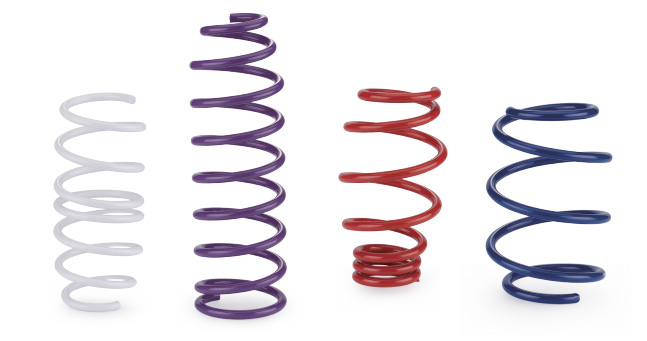 OE Replacement Suspension Springs for Cars and TrucksThis listing covers factory-spec replacement springs designed to restore original ride height and spring rate. It suits owners prioritizing predictable handling and comfort without altering the vehicle's stock suspension geometry.View Product →
Modified and performance springs
Modified suspension springs are usually fitted at a lower ride height and with a higher spring constant to reduce body roll. The purpose is not simply to make the car stiffer; it is to shift the usable frequency range toward better steering response and stability at the cost of some ride compliance.
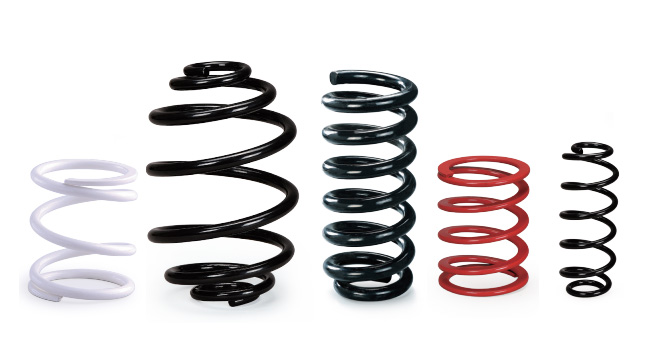 Modified Off-Road and Road Car Suspension SpringsUpgraded springs here target reduced body roll and lower ride height while improving steering response. They serve enthusiasts who accept stiffer compliance for better stability on pavement or demanding off-road terrain.View Product →
For a detailed comparison of linear and progressive designs, read how linear and progressive spring rates compare.
Verifying the Spring Constant
Production suspension springs are not defined by free length alone. A reliable supplier measures the load at specified compressed heights and reports the spring rate within a tolerance.
- Install the spring on a calibrated compression tester.
- Seat the spring between flat plates or spring seats that match the vehicle geometry.
- Compress the spring to a preload height and record the force.
- Compress to a second defined height and record the force again.
- Subtract the two loads and divide by the deflection to obtain the spring constant.
Manufacturers that follow IATF/TS16949 quality procedures usually control the spring rate with a tolerance of roughly ±5% for standard helical suspension springs. The load at a specified height is often a more practical acceptance criterion than the theoretical spring constant alone.
Zhejiang Zongheng Spring Co., Ltd. applies this measurement approach in its laboratory, using load testers, fatigue testers, and material analysis equipment to verify batch consistency. If you need springs with a defined spring constant, contact our engineering team with your vehicle type, target rate, and load requirements.
Suspension Spring Constant FAQ
What is a typical spring constant for a car suspension spring?
Most passenger-car coil springs have a linear rate between 20 and 60 N/mm. Compact cars tend to be near the lower end, while SUVs and performance cars sit near the higher end. The exact value depends on axle load and suspension design.
Is a higher spring constant always stiffer?
Yes, for a linear spring. A higher k means more force is required for each millimetre of deflection. But the feel also depends on motion ratio, damping, tyre stiffness, and bump stops.
Can I measure the spring constant without removing the spring?
Not accurately. The spring needs to be unloaded from the car or at least measured on a suspension dynamometer to obtain a reliable load-deflection curve. Wheel-rate calculations from bounce tests are useful for verification but include the influence of tyres and bushings.
What happens if the spring constant is too high?
A rate that is too high reduces suspension travel usage, transmits more road shock to the body, and reduces tyre compliance on rough surfaces. It can also overpower the damper and make the vehicle feel skippy.
Can cutting a coil spring change its spring constant?
Cutting a coil removes active coils and increases the spring rate, but it also changes the spring's seating surfaces and can create stress concentrations. It is not a reliable way to tune a suspension and is usually not recommended for road vehicles.