

 English
 中文简体
中文简体 Deutsch
 Español
When the front of your car sits noticeably lower on one side, or the steering wheel pulls slightly under braking, the coil front suspension springs are the first parts to check. A coil front suspension is the standard front spring layout on most passenger cars: a helical steel spring sits between the control arm and the chassis, or around the damper inside a strut, to carry the front axle weight and absorb road impact. Springs are the load-bearing elements of the system, so their condition affects steering, braking, and ride height even when the dampers are still healthy.
Content
- What Is a Coil Front Suspension?
- Double Wishbone vs. MacPherson Strut: Which Layout Uses Which Spring?
- Constant Rate vs. Progressive Rate Front Springs
- Spring Rate: The Specification That Controls Ride and Handling
- What Causes Front Coil Springs to Fail
- Replacing Front Coil Springs: What to Match and What to Avoid
- Coil Springs vs. Leaf Springs, Torsion Bars, and Air Springs
- Frequently Asked Questions About Coil Front Suspension
What Is a Coil Front Suspension?
A coil front suspension supports each front corner with a coil spring that compresses to absorb impacts and rebounds to return the wheel to its original position. The spring is the load-bearing element; the damper only controls how fast the spring moves. That is why a worn spring changes ride height, while a worn damper changes motion control. Both symptoms feel different and require different parts.
In a double-wishbone layout, the spring sits between the lower control arm and the chassis crossmember. In a MacPherson-strut layout, the spring surrounds the damper rod and the strut top mount bolts to the body. The suspension geometry, spring axis, and mounting points determine how the spring load is distributed during cornering and braking.
Double Wishbone vs. MacPherson Strut: Which Layout Uses Which Spring?
Decide on the layout before you order front springs; it defines the spring type, the installation procedure, and the alignment adjustments available after assembly.
Double Wishbone with Coil Spring
Two control arms guide the knuckle, and the coil spring stands between the lower arm and the frame. This layout provides stronger camber control and more space for large-diameter springs, which is why SUVs, pickups, and performance sedans use it.
MacPherson Strut
The strut combines the damper and spring in one assembly. The spring seats on the lower spring seat, and the top mount fastens to the body. It saves weight, cost, and packaging space, making it the default for compact and midsize cars.
| Property | Double Wishbone | MacPherson Strut |
|---|---|---|
| Camber control | Superior, especially under cornering | Moderate; depends on top mount design |
| Packaging space | Needs more vertical room | Compact and easy to package |
| Parts count | Higher | Lower |
| Spring replacement | Accessible after lower arm removal | Requires spring compressor for strut disassembly |
Constant Rate vs. Progressive Rate Front Springs
Constant-rate springs are the safer default for original-equipment replacement. Progressive-rate springs are worth choosing when the vehicle carries widely varying loads or when you want a softer initial ride with a stiffer reserve under compression.
A constant-rate spring compresses at the same force per millimetre throughout its travel. A progressive-rate spring is wound with variable coil spacing or a tapered wire, so the rate increases as the spring compresses. This creates a comfortable response over small bumps and a firmer response when the suspension is heavily loaded.
| Characteristic | Constant Rate | Progressive Rate |
|---|---|---|
| Rate behaviour | Same rate over full travel | Rate rises with compression |
| Ride comfort | Predictable and linear | Soft over small bumps, firm under load |
| Load capacity | Must select a higher-rate spring | Built-in reserve without constant harshness |
| Best application | OE replacement, standard driving | Towing, lifted or lowered vehicles |
Spring Rate: The Specification That Controls Ride and Handling
Spring rate is the force required to compress a spring by one unit of distance, measured in N/mm, and it is the most important specification when selecting a front coil spring because it directly controls ride height, pitch, and load capacity.
Rate depends on four factors: wire diameter, mean coil diameter, number of active coils, and the shear modulus of the steel. Wire diameter has the strongest influence; doubling it increases the rate by the fourth power. Typical OE front springs on a midsize sedan fall between 25 and 55 N/mm, while heavy-duty or sport springs can exceed 80 N/mm.
Production quality matters as much as the design. Shot peening and pre-setting are standard steps for high-fatigue-life springs: shot peening closes microscopic surface cracks, and pre-setting compresses the spring beyond its elastic limit to stabilise the free length. A spring made with controlled heat treatment and verified rate tolerances will keep its original ride height and rate far longer than a part built with loose process control. When ordering replacement units, ask for the free length, load rating, and rate tolerance so you can compare them with the old spring before fitting.
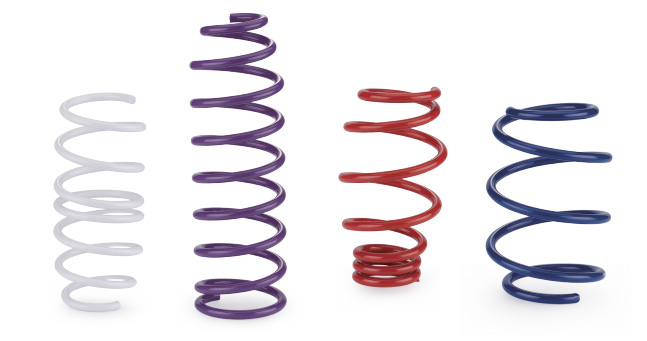 OE Replacement Car Suspension Springs with Precision ManufacturingThese OEM-style springs are made from high-strength steel with shot peening, pre-setting, and corrosion-resistant treatment. They suit drivers replacing worn front springs who need consistent ride height and fatigue resistance.View Product →
What Causes Front Coil Springs to Fail
Front coil springs fail gradually rather than suddenly. The main causes are fatigue, surface corrosion, overloading, and installation damage.
- Fatigue. Every bump and road joint adds a stress cycle. When surface stress exceeds the endurance limit of the steel, micro-cracks grow until the spring shortens or fractures.
- Corrosion. Stone chips and road salt damage the powder coating or e-coat layer. Moisture then reaches the steel surface and accelerates crack initiation.
- Overloading. Frequent bottoming out, repeated kerb impacts, or carrying loads beyond the rated capacity pushes the spring past its design stress.
- Incorrect installation. Twisting the spring during fitting, using the wrong spring seat, or omitting the insulator creates bending loads the spring was not designed for.
If the front of the vehicle sits lower on one side, the coil gaps are uneven, or you hear clunks over low-speed bumps, inspect the springs before replacing the shock absorbers. Knowing the five warning signs of automobile suspension spring fatigue can help you avoid paying for two repairs instead of one.
Replacing Front Coil Springs: What to Match and What to Avoid
Match the OE spring rate, free length, and load rating unless you are intentionally changing vehicle behaviour. Choosing a shorter or weaker spring simply to lower the nose usually reduces bump travel and increases the risk of bottoming out.
Original-Equipment Replacement
For an OE replacement, select a spring with the same wire diameter, coil count, free height, and rated load at a defined compression height. Replace springs in axle pairs, and replace the rubber isolators, bump stops, and dampers if they show wear at the same time. Beware of springs sold without measurable specifications: a front coil spring should always come with its free length, wire diameter, coil count, rate, and load rating at a defined height. After installation, measure ride height side to side and reset the alignment; spring height directly affects camber and toe.
Modified Springs for Lowering or Extra Load
If the goal is a lower centre of gravity, better body control, or a higher load capacity, use a spring with an intentional rate and height change rather than cutting or heating the original spring. The same inspection logic used to judge whether a car suspension spring needs replacement applies to modified springs: measure the free length, check coil gaps, and verify the load at a defined compression height. Confirm that the maximum compressed length of the spring does not exceed the bump-stop clearance of the suspension.
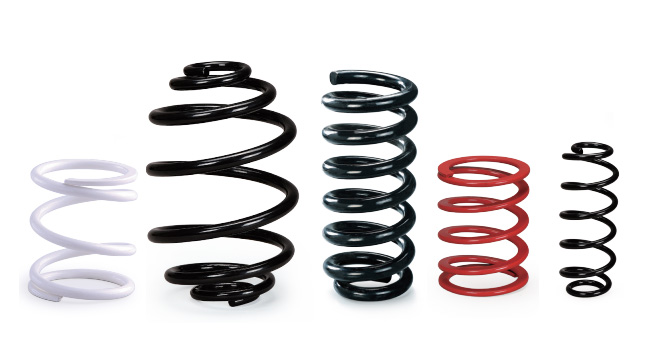 Customized Suspension Springs for Modified and Off-Road VehiclesEngineered for high loads, impacts, and rough terrain, these springs use heat-treated high-strength steel for durability. Ideal for enthusiasts tuning ride height or load capacity in road or off-road vehicles.View Product →
Coil Springs vs. Leaf Springs, Torsion Bars, and Air Springs
Coil springs suit most passenger cars best because they combine low cost, low maintenance, and linear rate behaviour in a compact package, but they are not always the right answer for commercial or luxury applications.
| Type | Ride Comfort | Load Capacity | Maintenance | Common Use |
|---|---|---|---|---|
| Coil spring | Good | Moderate | Low | Passenger cars, light SUVs |
| Leaf spring | Basic | Very high | Moderate (bushing wear, lubrication) | Trucks, solid front axles |
| Torsion bar | Moderate | Moderate | Low | Older trucks and SUVs |
| Air spring | Excellent | Adjustable | High (compressor, lines, sensors) | Luxury cars, load-leveling systems |
Frequently Asked Questions About Coil Front Suspension
How often should front coil springs be replaced?
There is no fixed interval because spring life depends on road quality, load, and corrosion exposure. Inspect springs during every suspension service, and replace them when one corner sits lower, when the vehicle feels floaty in corners, or when rust scaling and coating loss are visible. Many springs exceed 150,000 km, but 80,000 km is a realistic inspection checkpoint in regions with heavy road salt.
Can I replace only one front coil spring?
Technically yes, but it is not recommended. The new spring has a different free length and rate compared with the used spring on the opposite side, which creates asymmetric ride height and unpredictable handling. Replace coil springs in axle pairs even if only one side appears damaged.
Do progressive-rate springs improve towing stability?
They can, because the increasing rate provides a higher effective spring rate as the suspension compresses under load, reducing front-end pitch and body roll during towing. Make sure the progressive spring is matched to the front axle weight of the vehicle; a generic lowering spring will not provide the same reserve.
What happens if a front coil spring breaks while driving?
The affected corner drops, tyre wear changes quickly, and the steering may pull hard to the damaged side. In severe cases, a broken coil can contact the tyre or damage the strut. Pull over as soon as it is safe and have the car towed to the workshop to avoid further damage.
Does a new coil spring change the wheel alignment?
Yes. Ride height directly affects front camber, caster, and toe on many suspensions. After fitting new front springs, measure the alignment with the vehicle at normal kerb weight so the settings reflect the actual ride height.
A coil front suspension performs well only when the spring is correctly specified for the vehicle mass, the damper is matched to the spring rate, and the spring is inspected before fatigue becomes critical. Start from the OE specification, replace in axle pairs, and compare test certificates and measured data from the spring manufacturer when you evaluate options. If you are unsure which front spring fits your vehicle, a manufacturer with complete material inspection, fatigue testing, and rate validation facilities can supply parts matched to your requirement.