

 English
 中文简体
中文简体 Deutsch
 Español
The spring constant of a car suspension—often called spring rate or stiffness—is the amount of force required to compress the suspension spring by one unit of distance. For most passenger cars, this value lies between 25 and 60 N/mm. If the spring constant is too high, the ride feels harsh and skittish; if it is too low, the car sags, floats, and feels unstable. In simple terms, the spring constant sets the balance between comfort, load capacity, and handling.
Content
- What Is the Spring Constant of a Car Suspension?
- Why Does the Spring Constant Matter?
- Typical Spring Constant Values for Passenger Vehicles
- How to Calculate the Spring Constant from Coil Geometry
- Linear vs. Progressive Spring Rates
- How to Choose the Right Spring Constant for Your Car
- Modified Springs and Custom Spring Rates
- Signs That Your Suspension Springs Need Replacement
- Frequently Asked Questions About Car Suspension Spring Constants
What Is the Spring Constant of a Car Suspension?
In engineering terms, the spring constant (k) is defined by Hooke's Law as k = F / x, where F is the applied load and x is the compression or extension of the spring.
On a car, each corner of the suspension carries roughly one-quarter of the vehicle's weight plus dynamic load. A typical sedan weighing 1,400 kg with equal weight distribution puts about 3,430 N on each front spring. If that spring compresses 80 mm under that load, its spring constant is approximately 43 N/mm (3430 / 80).
Spring constants are expressed in newtons per millimetre (N/mm), newtons per metre (N/m), or pounds per inch (lb/in). To convert: 1 N/mm ≈ 5.71 lb/in. The stiffness value matters because it determines how far the spring compresses for every newton of force.
Why Does the Spring Constant Matter?
The spring constant is the main variable that determines how a car responds to bumps, body roll, and changes in load.
| Attribute | Soft Spring (Low k) | Stiff Spring (High k) |
|---|---|---|
| Ride comfort | Absorbs small bumps well | Transfers more impact to the cabin |
| Handling | More body roll, slower response | Less body roll, crisper cornering |
| Load capacity | Compresses a lot under weight | Maintains ride height under load |
| Tire contact | Good on rough surfaces | Better on smooth pavement |
This is why manufacturers choose different spring constants for the same platform depending on the engine, market, and target buyer.
Typical Spring Constant Values for Passenger Vehicles
Typical OE springs for passenger cars range from 25 to 60 N/mm, but the exact value depends on vehicle mass, suspension layout, and whether the manufacturer prioritizes comfort or sportiness.
| Vehicle Type | Spring Rate Range (N/mm) | Ride Frequency (Hz) |
|---|---|---|
| Compact city car | 20–35 | 0.8–1.2 |
| Mid-size sedan | 30–50 | 1.0–1.5 |
| SUV / light truck | 40–70 | 1.2–1.8 |
| Sports / performance car | 50–90 | 1.5–2.2 |
Rear springs are often stiffer than front springs to account for additional loads when the vehicle is fully occupied or carrying cargo.
How to Calculate the Spring Constant from Coil Geometry
For a coil spring, the spring constant can be calculated before the spring is built using the wire diameter, coil diameter, number of active coils, and the shear modulus of the material.
Formula: k = (G * d4) / (8 * D3 * n)
- G = shear modulus of spring steel, about 79,300 N/mm²
- d = wire diameter in mm
- D = mean coil diameter in mm
- n = number of active coils
Using 14 mm wire, 120 mm mean coil diameter, and five active coils gives k ≈ 44 N/mm, which is a typical front spring for a mid-size sedan. Increasing wire diameter to 15 mm raises k to about 58 N/mm.
Linear vs. Progressive Spring Rates
The spring constant is not always constant in real springs: linear springs keep the same k through full compression, while progressive springs increase k as the spring compresses.
- Linear springs: predictable, easier to tune with dampers, common in OE and track-oriented cars.
- Progressive springs: comfortable initial travel, higher resistance at large compression, useful for vehicles that carry varying loads.
Most OE applications use linear springs because they give consistent wheel control. Progressive springs are a popular choice when a vehicle must balance daily comfort with occasional heavy loads.
How to Choose the Right Spring Constant for Your Car
To choose the correct spring constant, you must match it to the vehicle's axle loads, suspension geometry, dampers, and intended driving needs.
- Determine the corner weights of the vehicle.
- Decide the load conditions: daily driving, frequent heavy loads, towing, or track work.
- Choose between linear and progressive spring rates.
- Match the dampers to the chosen spring rate to prevent oscillations.
- Verify spring free length and available suspension travel.
For factory-like ride quality without application-specific tuning, an OE replacement suspension spring is the safest option because it uses the original spring constant and material specifications.
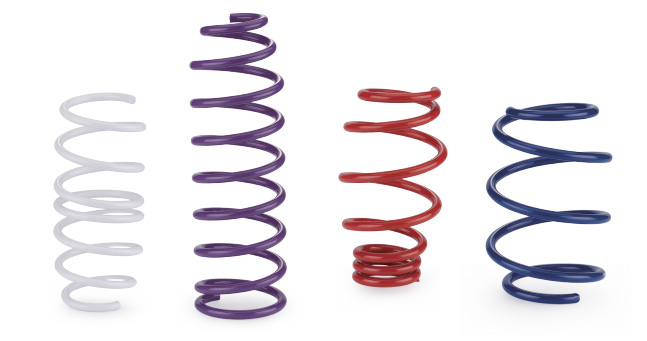 OE Replacement Suspension Springs for Factory Ride QualityThese springs use original spring constant and material specifications, making them a safe choice when you want factory-like ride comfort without custom tuning. They support stability and durability.View Product →
Modified Springs and Custom Spring Rates
Modified car suspension springs deliberately change the spring constant or free length to adjust ride height, handling, or carrying capacity.
- Lowering springs: shorter free length with a higher spring constant to maintain travel and reduce body roll.
- Leveling or lift springs: added rate to reduce sag when carrying heavy loads or towing.
- Progressive modified springs: improve comfort and load capacity using a variable-rate curve.
When choosing a modified spring, pay attention to the rate curve, not just the advertised drop, because a spring that is too stiff will overwhelm the dampers and hurt tire grip.
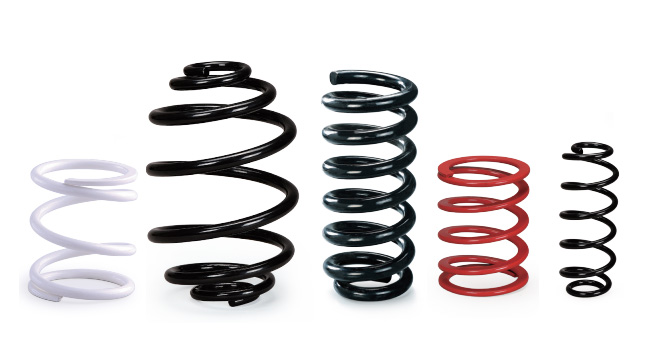 Modified Suspension Springs for Off-Road and Street UseDesigned for high loads and rough terrain, these springs offer enhanced durability and shock absorption. They suit modified vehicles and can also improve handling on road cars.View Product →
Signs That Your Suspension Springs Need Replacement
Once a spring fatigues and its spring constant changes, the vehicle shows warning signs before a complete break.
- Front or rear sits lower than factory ride height.
- Clunking noise from the suspension over bumps.
- Uneven tire wear or cupping.
- Bottoming out on normal driveways.
- Erratic steering and excessive body sway.
If you notice these symptoms, inspect the springs for cracks, sag, or broken coils. A detailed guide is available on five warning signs of automobile suspension spring fatigue.
Frequently Asked Questions About Car Suspension Spring Constants
The most common spring constant questions fall into three categories: measurement, selection, and compatibility.
What is a typical spring constant for a car suspension?
Most passenger cars fall between 25 and 60 N/mm; compact cars are near the low end, while sports cars and SUVs are near the high end.
How can I measure my car's spring rate?
You need a spring tester or a press with a load cell: measure force at a known deflection, then divide force by deflection. In a workshop, corner weight scales can estimate the static load on each spring.
Is a higher spring constant always better for handling?
No. Too high a spring rate reduces tire compliance over bumps and can break grip. Handling is a compromise between spring rate, damping, ride height, and tire characteristics.
Can I use modified springs with the same dampers?
Only if the damper's compression and rebound tuning match the new spring rate. If you increase the spring constant significantly, you should upgrade the dampers to prevent oscillation. For specific replacement rates, contact our engineering team.