

 English
 中文简体
中文简体 Deutsch
 Español
Short answer: A damper converts the kinetic energy of suspension movement into heat by forcing oil and gas through calibrated openings, which is why a car stops bouncing after a bump instead of oscillating for several seconds. In the automotive world, the damper is the shock absorber. The same word is also used for airflow-control blades in HVAC ductwork, but that mechanism is completely different. This guide explains how vehicle dampers work, how they work with suspension springs, and what happens when the pair is not matched correctly.
Content
What Is a Damper?
A vehicle damper is a hydraulic or gas-charged component that resists suspension movement, and its only job is to control how quickly the coil spring compresses and rebounds.
When a wheel hits a bump, the spring absorbs the impact by compressing and storing energy. If nothing controlled that energy, the spring would release it all at once and the car would keep bouncing several times before settling. The damper removes that energy by converting it into heat. Every time the suspension moves, internal fluid is forced through small valves, and the friction of the fluid creates the resistance you feel as a controlled, firm ride.
A useful fact to remember: after a hard drive on a rough road, a damper body can reach roughly 100 to 120 °C. That heat is the proof that the damper is doing its job, because the kinetic energy of the suspension has to go somewhere.
How Does a Damper Work Step by Step?
A damper works in two strokes: the compression stroke and the rebound stroke, and the resistance is produced by fluid passing through valves inside the tube.
- The wheel hits a bump and moves upward.
- The coil spring compresses and stores kinetic energy.
- The damper piston moves into the fluid, forcing oil through the compression valve and creating resistance.
- On rebound, the spring releases its energy, and the damper resists again to settle the body smoothly.
Compression stroke
When the wheel moves up over a bump, the piston, rod, and fluid are forced into a smaller volume, so the oil is pushed through the compression valve, creating a resistance that slows the spring's compression.
Rebound stroke
When the spring pushes the wheel back down, the piston moves in the opposite direction, forcing oil through the rebound valve, and in most modern dampers the rebound resistance is intentionally stronger than the compression resistance.
The reason is simple: the spring stores energy during compression and releases it suddenly during rebound. If the damper did not resist harder on rebound, the spring would throw the wheel down and the body would oscillate.
Damping force depends on speed, not load
The faster the piston moves, the higher the damping force becomes, which is why a damper feels soft during slow body roll but firm over a sharp impact.
This velocity-dependent behavior is designed into the valve shims and orifice sizes. Slow movements, such as weight transfer while cornering, produce small forces. Fast movements, such as a pothole edge, produce high forces that keep the wheel on the road. This is the defining characteristic of how a damper works.
Types of Vehicle Dampers
The working principle is the same across nearly all passenger-car dampers, but the internal construction changes performance, heat tolerance, and cost.
| Type | Working principle | Typical use | Key characteristic |
|---|---|---|---|
| Twin-tube | Two cylinders; oil passes through base valve and piston valve | OE comfort-oriented cars | Lower cost, forgiving ride, good heat storage |
| Monotube | Single cylinder with a free-floating gas piston | Sports and performance cars | Better heat dissipation, faster response, higher cost |
| Gas-charged | Low-pressure nitrogen prevents oil foaming | Most modern vehicles | Consistent damping at high temperatures |
| Coilover assembly | Damper and coil spring combined with an adjustable seat | Modified and track cars | Height and preload adjustment in one unit |
The right choice depends on the vehicle class, the spring rate, and the intended use. A comfort-oriented family car typically uses a twin-tube oil damper, while a suspension that has to deal with repeated high-speed inputs benefits from the heat rejection of a monotube design.
How Dampers and Springs Work Together
Damping controls the spring's motion, so a damper has no meaningful performance value unless the spring rate is known.
In a typical car, the suspension spring absorbs the road impact, and the damper turns the spring's energy into heat. The two parts are opposite in function but inseparable in design. Most OE suspension springs for passenger cars have rates between roughly 20 and 45 N/mm, and the damper is tuned to that specific range. If the spring is too soft, the suspension bottoms out before the damper can act; if the spring is too hard, the damper cannot absorb enough energy and the ride becomes harsh.
This is why OE replacement car suspension springs are manufactured to precise free length, outer diameter, and spring rate. A new spring with a fatigued or mismatched damper will not restore the original balance, because the damper has to be matched to the rate that the spring actually produces. For a deeper explanation of the spring side of this pair, read what car suspension springs actually do.
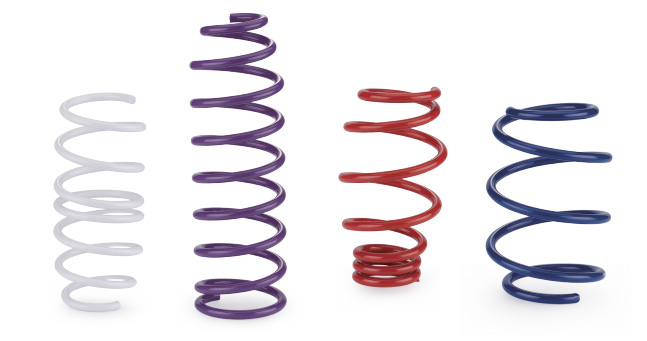 OE Replacement Car Suspension Springs Manufacturers, SuppliersZhejiang Zongheng Spring Co., Ltd. is a China OE Replacement Car Suspension Springs manufacturer and suppliers, Specializing in wholesale...View Product →
For modified vehicles, the situation is even more demanding. Lowering the car shortens suspension travel and often increases spring rate, which changes the speed at which the damper has to operate. Without extra damping control, the car either feels pogo-stick stiff or bottoms out on every dip. That is why modified car suspension springs are usually installed together with dampers that have stronger rebound resistance.
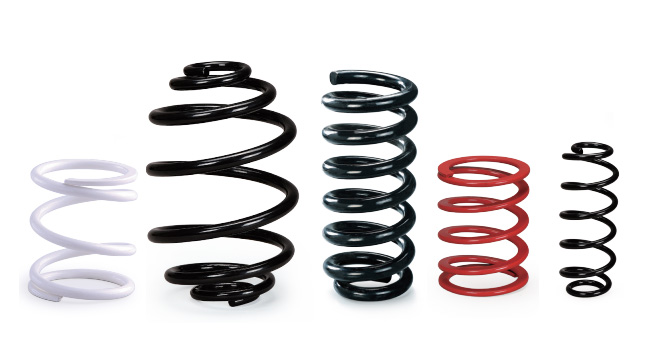 Modified Cars Off-Road Vehicles Suspension Springs ManufacturersZhejiang Zongheng Spring Co., Ltd. is Leading China manufacturer of wholesale suspension springs for modified cars & off-road vehicles. S...View Product →
What Happens When a Damper or Spring Wears Out
A worn damper lets the spring oscillate almost freely, which shows up as prolonged bouncing, vague steering, and longer stopping distances.
- The car continues to bounce two or three times after crossing a speed bump
- The front nose dives hard under braking, and the rear rises during acceleration
- An oil streak on the damper body indicates the piston seal has failed
- Tires develop scalloped or cupped wear patterns
A fatigued suspension spring produces similar symptoms, including a lower ride height on one corner and clunking noises over small irregularities. When one side of the axle is worn, the spring and damper on the other side are forced to work harder, so a single failed part accelerates the wear of the whole suspension. Acting early matters, and the five warning signs of suspension spring fatigue are a practical checklist for drivers.
What About HVAC Dampers and Other Types?
In ducted heating and cooling, a damper is a movable blade inside the ductwork that opens, closes, or partially blocks the airflow passage.
HVAC dampers work mechanically: a manual lever or an electric actuator rotates the blade, and a zone damper opens when the thermostat in that room calls for heating or cooling. Fire dampers, by contrast, close automatically when the heat from a fire melts a fusible link, typically at around 165 °F (74 °C), sealing the duct to stop flames and smoke from spreading. The working principle is different from a shock absorber, but the intent is the same: to control the flow of energy, whether it is airflow energy or suspension kinetic energy.
Frequently Asked Questions
The short answers below cover the most common concerns that come up when drivers start researching dampers.
Is a damper the same as a shock absorber?
Yes, in automotive use the terms mean the same component. "Shock absorber" is more common in parts catalogs, while "damper" appears more in engineering documents and suspension tuning discussions.
Why does a car bounce even with new dampers?
A new damper can only control the energy that the spring releases; if the spring has fatigued, the ride height drops and the damper loses stroke. Replace the spring as well, and check how to judge whether a car suspension spring needs to be replaced.
Can I replace springs without replacing dampers?
It is technically possible, but not recommended. A high-mileage damper has lost gas pressure and oil volume, so it will not provide the control that a fresh spring needs. Replace both as a pair whenever one side has failed.
Do lowering springs need different dampers?
Yes. Lowering springs reduce travel and often increase spring rate, so the damper must provide stronger rebound control. Using lowering springs with stock dampers produces a hard, poorly controlled ride and shorter damper life.
What is the difference between a damper and a strut?
A strut is a structural suspension member that contains a damper inside and also supports the vehicle weight, while a damper that is not a strut only controls suspension motion. Cars with strut fronts use the strut as the upper locating point of the wheel, so it sees much higher side loads.
The Bottom Line
A damper works by converting kinetic energy into heat through controlled hydraulic resistance, and it can only do its job when the coil spring has the correct rate and free length.
Because the two parts operate as one system, always evaluate them together. At Zhejiang Zongheng Spring, every suspension spring is produced under the IATF/TS16949 quality system and tested for load, rate, and fatigue life before delivery. Pair a properly manufactured spring with a healthy damper, and the car will behave the way the suspension designer intended.