

 English
 中文简体
 Deutsch
 Español
Hitch up a 6,000 lb travel trailer and a typical half ton pickup takes roughly 700 lb of tongue weight at the ball. Leverage pushes close to 950 lb of that onto the rear axle, and two coil springs carry all of it. When the rear drops two inches, the headlights point at the sky, the steering goes light, and the springs are running far past the deflection they were designed for.
The short answer: heavy duty coil springs for towing work when their load rating covers your loaded rear axle weight, their rate matches how the truck is actually used, and the installed height stays close to stock unless you are deliberately changing ride height. Stiffness by itself fixes nothing. A spring that is too short or too tall just moves the problem into the shocks, the bump stops, or your spine.
Content
- What "Heavy Duty" Really Means in a Towing Coil Spring
- Why Stock Coils Sag Once the Trailer Is Hitched
- Linear or Progressive? Matching Winding Style to Your Tow Routine
- How to Size Heavy Duty Coil Springs to Your Real Towing Load
- Lifted Trucks: When a Heavier Coil Also Changes Ride Height
- How to Tell a Good Heavy Duty Coil Spring Before You Install It
- Frequently Asked Questions
What "Heavy Duty" Really Means in a Towing Coil Spring
Heavy duty is a load rating and a fatigue life, not a paint colour. Two rear coils can look identical on the bench and differ by 40 percent in how much weight they hold at a given height. What separates them is wire diameter, coil diameter, free length, and the rate those measurements combine to produce.
- Wire diameter. The biggest single lever. Going from 0.625 in wire to 0.750 in raises spring rate far more than most buyers expect, because rate scales roughly with the fourth power of wire diameter.
- Coil diameter and active turns. A wider coil and more active turns soften the spring; fewer, thicker turns stiffen it.
- Spring rate, in lb/in. The load needed to compress the spring one inch. This is the number to compare when shopping, not the words "heavy duty" on the box.
- Free length and installed height. The right rate with the wrong free length will either sit the truck too low or leave it riding on the bump stops.
- Material and treatment. Chrome silicon or SAE 5160 grade wire, controlled heat treatment and shot peening decide whether a spring holds its height after 100,000 miles or sags in a single season.
| Specification | Stock rear coil | Heavy duty, stock height | Heavy duty, lifted |
|---|---|---|---|
| Wire diameter | 0.625 in | 0.687 to 0.750 in | 0.750 to 0.812 in |
| Spring rate | 180 to 220 lb/in | 260 to 320 lb/in | 300 to 400 lb/in |
| Load rating per pair | About 1,400 lb | About 2,400 lb | About 2,800 lb |
| Installed height | Factory | Factory | 1 to 3 in above factory |
| Best suited to | Empty and light loads | Towing inside the rear GAWR | Levelled trucks with heavy trailers |
| Main trade off | Squats quickly under load | Firmer ride when empty | Needs shocks, alignment and bump stop checks |
Why Stock Coils Sag Once the Trailer Is Hitched
Sagging springs are usually not broken, they are simply pushed past their working range. Run the arithmetic on a stock rear spring rated near 200 lb/in per side. A 700 lb tongue weight, measured about 50 in behind a 145 in wheelbase, becomes roughly 945 lb at the rear axle. Split across two springs, that is about 472 lb each, which compresses each spring close to 2.4 in.
That number matters more than it looks. At 2.4 in of droop the spring is still elastic, but the shock absorber is near the end of its travel, the gap to the bump stop has almost vanished, rear pinion angle has changed, and the front axle has unloaded by roughly the same amount. Light steering, a wandering rear end and headlights aimed at oncoming traffic are all symptoms of the same geometry problem, not three separate faults. If the loaded rear axle weight also pushes past the GAWR on the door sticker, no spring upgrade makes the combination legal or safe.
Linear or Progressive? Matching Winding Style to Your Tow Routine
If the truck is loaded most of the time, a linear heavy duty coil is easier to predict and cheaper to live with. If you tow on weekends and commute empty during the week, a progressive spring keeps the unloaded ride civil while still carrying the load.
A linear spring costs the same amount of load for every inch of compression, so the truck settles at a height you can calculate in advance. A progressive spring starts soft on its closely spaced coils and stiffens as the tighter coils bind, which is why it rides better with an empty bed. The trade off is that a heavily loaded progressive spring can coil bind if the rate climbs too far, and it is harder to predict how much height you will lose at a given tongue weight. Coil bind, free length and rate progression are the three points worth comparing before you buy; our guide to choosing between linear and progressive OE replacement suspension springs walks through that comparison in detail.
How to Size Heavy Duty Coil Springs to Your Real Towing Load
Size the spring around a measured load, not a guess. Five numbers decide the purchase, and four of them come from a scale.
- Load the truck and trailer exactly as you would for a trip, including water, fuel, passengers and gear, then weigh the tongue at a public scale.
- Measure from the rear axle centre to the hitch ball. Divide that distance by the wheelbase and add one to get the rear axle multiplier, usually between 1.3 and 1.4 on a pickup.
- Multiply tongue weight by that multiplier, then compare the result with the GAWR on the door sticker minus the empty rear axle weight from a weighbridge.
- Choose a rate that limits rear sag to about 1 to 1.5 in when loaded. For a 900 lb increase at the rear axle, a pair rated near 300 lb/in is a realistic starting point.
- Check free length and installed height against the stock spring so the truck sits where you intended, and budget for shocks, fresh bump stops and a rear alignment at the same time.
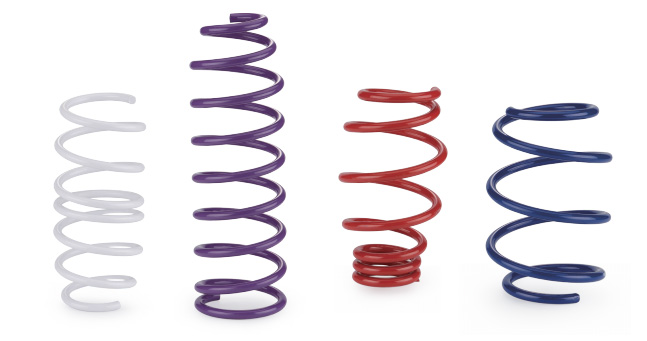 OE Replacement Automobile Suspension Springs for Cars and TrucksReplacement springs for sedans, SUVs, trucks, and buses, designed to restore ride height, load capacity, handling, comfort, and safety.View Product →
Lifted Trucks: When a Heavier Coil Also Changes Ride Height
A heavy duty coil that adds two inches of lift is a suspension change, not a spring swap. The extra height has to be matched everywhere else or the truck will handle worse than it did when it squatted.
- Shock absorbers must be long enough to keep the spring seated at full droop, otherwise the coils top out over every expansion joint.
- Bump stops, brake lines, ABS wiring and the parking brake cable all need checking for the new travel range.
- Pinion angle and driveshaft angle change with height, which shows up as a vibration that starts around 45 mph.
- The hitch drops with the rear of the truck, so recheck trailer level and adjust the ball mount height accordingly.
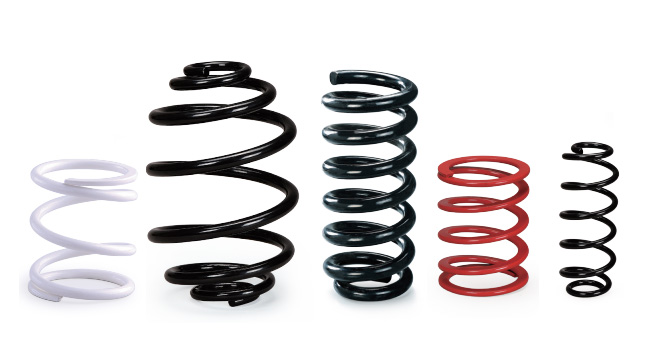 Modified Car Suspension Springs for Off-Road and Road CarsOff-road and road-car modified springs using high-strength steel, heat treatment, and tuning options for lift, load, and handling.View Product →
How to Tell a Good Heavy Duty Coil Spring Before You Install It
The difference between a spring that lasts a decade and one that sags in a year shows up in the paperwork, not the photograph. Ask for three things: the wire grade, the spring rate in lb/in, and a load or fatigue test result tied to the production batch.
Grade matters because 5160 and chrome silicon wire tolerate repeated cycling without taking a set, and shot peening adds a compressive layer at the surface that delays fatigue cracks. Heat treatment control is where cheap springs fail quietly, since an inconsistent temper can leave one side two tenths of an inch shorter than the other. A manufacturer working under IATF/TS16949 controls, with its own fatigue and side load benches, can usually hand over that batch data. Zhejiang Zongheng Spring Co., Ltd., for example, publishes exactly this kind of per batch testing approach from its suspension spring production, which is a useful benchmark when a seller cannot tell you the rate of the spring being sold.
Frequently Asked Questions
Do I need new shocks with heavy duty coil springs?
Yes, in most cases. If the new spring is more than about 20 percent stiffer, or changes ride height, the original shock cannot control the spring's return energy. The result is a bouncy, floaty rear end that feels worse than the sagging springs you replaced. Match the shock to the new rate and to the new static height.
Will heavier rear springs make my empty truck ride harsh?
Somewhat, and that is the honest trade off. A linear spring rated near 300 lb/in will feel firm with an empty bed, while a progressive spring of the same load rating stays closer to stock when unloaded. Keeping tyre pressures at the light load setting, rather than the maximum on the sidewall, recovers a noticeable amount of comfort.
Are air bags a better answer than heavy duty coil springs for towing?
They solve different problems. Air bags adjust height and stiffness for a changing load, which suits a truck that tows occasionally, but they add lines, fittings and a leak path, and they do not restore a spring that has already lost height or rate. A heavy duty coil spring fixes the underlying rate and height; helper air bags can then fine tune the last inch of attitude. Combining a tired spring with bags simply loads a worn part harder.
How much rear sag is acceptable when towing?
Aim for under 1 in of drop from the unloaded height, and treat anything past 1.5 in as a sign the springs are undersized or already fatigued. Measure from the wheel arch to the hub centre before and after hitching, on level ground, with the trailer loaded as usual.
Do heavy duty springs increase my truck's payload rating?
No. The GVWR and GAWR on the door sticker are set by the manufacturer and are not changed by aftermarket parts. Stiffer springs improve attitude, stability and headlight aim, but the legal limit for what you can carry is unchanged.
Measure the load first, then buy the spring. A rear axle increase of around 900 lb, a target of no more than 1.5 in of sag, and a rate in the 260 to 320 lb/in range will cover most half ton towing setups without turning the truck into a brick. Get the rate, free length and shock control right, and a heavy duty coil spring becomes the least interesting part of your towing package, which is exactly what you want from it.