

 English
 中文简体
中文简体 Deutsch
 Español
Fork springs are the helical compression springs that sit inside a telescopic fork and hold the vehicle, rider, and luggage at the right ride height while absorbing the bumps the damper cannot. Making them is not complicated in principle: coil the wire, relieve the stress, grind the ends, shot peen, preset, coat, and test. What separates a spring that still holds its free length after 30,000 km from one that sags within a season is the control applied to those steps, not the idea behind them.
For anyone sourcing fork springs, the short answer comes first: fix the installed length, the load at that length, the available travel, and the corrosion environment before anything else. Spring rate, wire diameter, coil count, and material all follow from those four numbers. Ask for a rate band rather than a single value, confirm that every spring is preset, and check that the coating survives a salt spray test.
Content
- What a Fork Spring Does, and What the Term Covers
- Fork Spring Manufacturing, Step by Step
- Wire Materials: What Each Grade Buys You
- Tolerances Worth Writing into the Drawing
- Linear, Progressive, and Dual-Rate: Choosing the Curve
- Why Fork Springs Fail Early
- A Sourcing Checklist for Fork Spring Manufacturing
- Cost, Tooling, and Lead Time: What Moves the Price
- Frequently Asked Questions
What a Fork Spring Does, and What the Term Covers
A fork spring is defined by its job rather than its shape: it carries static load, sets ride height, and returns energy over bumps.
On a typical motorcycle, roughly 25 to 35 percent of the available travel disappears under the weight of bike and rider. That sag figure is set by spring rate and preload spacer length, and it decides whether the fork works in the middle of its travel or wastes the first third of it. The damper controls how fast the fork moves; the spring decides where it sits and how much force it takes to move it.
Fork springs appear in telescopic forks on motorcycles, adventure and enduro bikes, ATVs, snowmobiles, and mountain bikes, including inverted and cartridge designs. Mechanically they are ordinary helical compression springs, so the same coiling, heat treatment, shot peening, and test equipment that makes a fork spring also makes the general-purpose coil springs used in industrial machinery. The difference between the two markets is the acceptance criteria, not the process: fork springs are rated, matched in pairs, and fatigue tested, while an industrial spring may only be checked for free length and load.
Fork Spring Manufacturing, Step by Step
Each step below affects either the finished rate or the fatigue life, which is why sequence control matters more than any single machine.
- Incoming wire inspection. Every coil of chrome silicon or music wire is checked for diameter, tensile strength, and surface defects such as seams and decarburization. Diameter control is critical because rate changes roughly with the fourth power of wire diameter: a 0.02 mm error on 4.5 mm wire moves the rate by about 4 percent.
- Coiling. Fork springs are almost always cold coiled on CNC coilers; hot coiling is reserved for wire above roughly 8 mm. Pitch is set slightly longer than the drawing requires, because presetting will shorten the spring.
- End forming and grinding. Closed and ground ends let the spring sit square against the fork cap and damper seat. Out-of-square ends create side load and stiction.
- Heat treatment. Chrome silicon is austenitized, oil quenched, and tempered to about 45 to 50 HRC, followed by a stress relief pass that removes the residual stresses left by forming.
- Shot peening. Cast steel shot puts the surface layer into compression. This is the cheapest and most effective fatigue improvement available, and it is specified by coverage and Almen intensity rather than by a promise.
- Presetting (scragging). The spring is compressed to solid height or beyond its installed length, which deliberately yields the most highly stressed coils and stabilizes free length.
- Load and rate testing. Rate is measured between two defined lengths rather than at one point, and springs are sorted into bands so pairs can be matched.
- Surface finishing. Zinc phosphate plus powder coat, e-coat, or chrome plating. Coastal, winter, and off-road use push the specification toward heavier coating or stainless wire.
- Final inspection and documentation. Load test, coating thickness, dimensional report, and lot traceability for every batch.
Buyers are really evaluating capability at each of those steps. A manufacturer that coils, heat treats, peens, presets, and tests under one roof can show batch data; one that outsources heat treatment usually cannot. The same production line also feeds OE replacement suspension springs for cars and light commercial vehicles, which share the coiling, heat treatment, and shot peening stages.
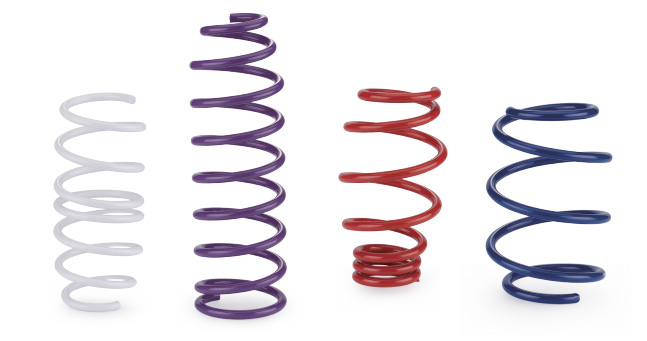 Automobile Suspension Springs for OE Replacement and Custom ApplicationsBrowse automotive suspension springs made to OE dimensions, load and performance specs, with materials and manufacturing options for shock absorption and durability.View Product →
Wire Materials: What Each Grade Buys You
Chrome silicon is the default for repeated hard use; stainless buys corrosion resistance at the cost of roughly 10 percent of the rate for identical geometry; music wire is a low-cost choice for light, dry applications only.
| Wire grade | Typical tensile strength | Strengths | Limitations |
|---|---|---|---|
| Chrome silicon (ASTM A401 / 51CrV4) | 1,800–2,100 MPa | Best fatigue resistance, stable at high stress | Needs quench and temper, higher unit cost |
| Oil-tempered MB (ASTM A229) | 1,500–1,800 MPa | Low cost, easy to coil | Shorter fatigue life, more sag under sustained load |
| Music wire (ASTM A228) | 1,900–2,200 MPa | Highest tensile, ideal for thin wire | Loses load above 120 °C, poor corrosion resistance |
| Stainless 302 / 304 | 1,300–1,600 MPa | Corrosion resistance without coating | About 10% lower rate, lower fatigue strength |
| 17-7PH stainless | 1,600–1,900 MPa | Strength and corrosion resistance together | Expensive, limited availability |
| Titanium Ti-6Al-4V | 900–1,100 MPa | Roughly 40% lighter than steel | Low modulus, larger coil for the same rate, high cost |
Tolerances Worth Writing into the Drawing
Specify rate as a range, free length as a minimum and a maximum, and treat presetting as a required operation rather than an optional extra.
| Characteristic | Typical tolerance | Why it matters |
|---|---|---|
| Wire diameter | ±0.02 mm | Rate follows the fourth power of diameter, so 1% of diameter is about 4% of rate |
| Free length | ±1.0 mm or ±1% | Sets preload, ride height, and the risk of coil bind |
| Spring rate | ±5% tight, ±8–10% standard | Pair matching matters more than absolute rate on a fork |
| Load at installed length | ±5–8% | This is the number the rider actually feels |
| Squareness of ends | ≤1.5% of outside diameter | Skewed ends load the fork tube sideways and cause stiction |
| Coating thickness | 60–120 µm | Below the range, salt spray life falls quickly |
| Preset stability | Free length loss ≤1% after preset | Prevents in-service sag |
| Fatigue test | Pass at specified stress for a defined cycle count | Confirms shot peening and heat treatment are under control |
Linear, Progressive, and Dual-Rate: Choosing the Curve
Most road and race forks use linear springs, because the damper should control progression; progressive or dual-rate springs help when travel is limited and load varies widely, such as a loaded adventure bike or a utility ATV.
A linear spring gives the same rate at 10 mm of travel as at 100 mm, which makes setup predictable: preload sets ride height, and oil level plus valving do the rest. A progressive spring raises its rate as it compresses, either because the pitch varies along the coil or because a closely wound section closes and stops working. That gives a plush first third of travel and firmer bottoming resistance, but it complicates damping setup and makes sag measurements less meaningful. Dual-rate designs sit between the two, with two distinct rates and a transition point you can place deliberately. The trade-offs are covered in more detail in this comparison of linear and progressive suspension springs.
Upgraded and custom-rate springs follow the same rules, whether the goal is a lower ride height, firmer support when loaded, or better stability under braking.
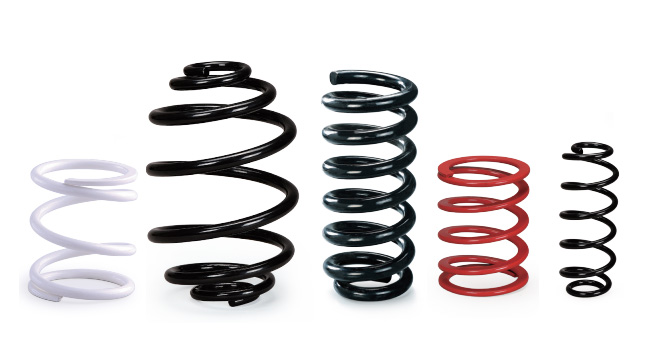 Modified Suspension Springs for Off-Road and Road CarsCompare custom-rate and lift springs for off-road vehicles and modified passenger cars, with options for ride height, load, and stability.View Product →
Why Fork Springs Fail Early
Almost every premature failure traces back to one of four causes: incomplete shot peening, missing or partial presetting, corrosion pitting, or a rate that was never verified after heat treatment.
- Sag. Free length shrinks several millimetres when presetting is skipped or when stress relief is too short, and the fork then rides lower and bottoms out sooner.
- Fatigue cracking. Cracks usually start at the first active coil next to a ground end, where stress concentration and residual tensile stress are highest.
- Corrosion pitting. A pit only 0.1 mm deep acts as a stress raiser and can cut fatigue life by an order of magnitude, which is why coating damage at coil contact points matters.
- Coil bind. If the gap between active coils is too small after preload, the spring goes solid before the fork reaches full travel and load spikes through the chassis.
- Rate drift from heat. Springs close to brakes or hot dampers lose load faster when the wire grade is not rated for elevated temperature.
A Sourcing Checklist for Fork Spring Manufacturing
Match the supplier's process control to the duty cycle of the spring, and ask for first-article data rather than a specification sheet.
- Where is the wire made, and are mill certificates supplied with every lot?
- What wire diameter and outside diameter range can be cold coiled, and what end forms are available?
- Is heat treatment done in house, and what hardness range is verified?
- What shot peening intensity and coverage are specified, and how often is Almen strip testing performed?
- How is presetting done, and is free length recorded before and after?
- Which tests can be run in house: load, rate, fatigue, salt spray, dimensional?
- What documentation is provided, from simple inspection reports to full PPAP submissions?
- What are the sample lead time, minimum order quantity, and coating options?
Send the installed length, load at that length, travel, target rate, and annual volume when requesting a quote or a design review; you can reach the engineering team through the contact page.
Cost, Tooling, and Lead Time: What Moves the Price
Wire grade and shot peening are the two biggest cost levers; tooling is rarely significant for cold-coiled fork springs.
- Wire grade: chrome silicon costs more per kilogram than oil-tempered MB, and stainless more again.
- Shot peening and presetting add cycle time but are the cheapest fatigue insurance available.
- Closed and ground ends cost more than closed ends alone, yet they remove stiction.
- Coating: powder coat over zinc phosphate costs more than e-coat or a simple oil finish.
- Volume: setup dominates small orders, while coating and testing dominate large ones.
- Documentation: full PPAP with fatigue data adds engineering hours, not material cost.
- Lead time: samples typically take two to four weeks after drawing approval, and production four to six weeks depending on wire availability and coating.
Frequently Asked Questions
What is the difference between a fork spring and a shock spring?
Both are helical compression springs, but fork springs are longer, lower in rate, and usually enclosed in a tube, which changes corrosion exposure and the way they are preloaded.
What wire diameter is typical for fork springs?
Motorcycle fork springs commonly use 3.5 to 6.5 mm wire with a 25 to 40 mm outside diameter and a free length of 300 to 600 mm; bicycle fork springs are thinner, around 1.6 to 2.5 mm.
Can a fork spring be cut to raise the rate?
Cutting removes active coils and does raise the rate, but the new end is neither closed nor ground, solid height changes, and stress per coil increases. It is usually better to specify a new spring.
What rate tolerance should I request?
±5% suits matched OEM pairs, while ±7 to 10% is common for aftermarket. Matching the two springs in a set to within 2 to 3% of each other matters more than the absolute figure.
How long should a fork spring last?
A properly preset, shot-peened chrome silicon spring should hold its free length within 1 to 2% over 50,000 km; without presetting, 5 to 8 mm of sag inside 20,000 km is common.
Fork spring manufacturing rewards process discipline more than equipment lists: wire control, in-house heat treatment, verified shot peening, and presetting on every part are what keep rate and free length stable over a service life. Define the installed length, load, travel, and environment first, hold the rate to a band, and let a supplier with an in-house laboratory prove it with batch data rather than a brochure.