

 English
 中文简体
中文简体 Deutsch
 Español
If you are replacing or upgrading coil springs for shocks, the first decision is not color or brand—it is matching the spring to the damper and the load. A coil spring that is 10% too stiff can make a new shock feel harsh; one that is too soft can let the body roll and bottom out. This guide gives you the specifications, comparisons, and buying checks that prevent return shipments and road-test failures.
Content
- What Coil Springs for Shocks Actually Do
- The First Decision: Match Spring Rate to Damper Valving
- Key Specifications to Confirm Before Ordering
- Material and Manufacturing: Where Fatigue Life Is Won or Lost
- OE Replacement vs Modified Coil Springs: A Practical Comparison
- Linear vs Progressive Coil Springs for Shock Absorbers
- Installation and Inspection: Avoiding the Most Common Mistakes
- FAQ
What Coil Springs for Shocks Actually Do
Coil springs for shocks carry the vehicle weight and absorb road input, while the shock absorber controls the spring's energy.
The spring compresses over bumps and extends after them. Without a shock, it would keep bouncing. The shock converts that motion into heat and limits body movement. In a strut assembly, the coil spring often also supports the upper spring seat and bearing. That is why spring rate, free length, and damper valving must be treated as one system.
| Function | Coil Spring | Shock Absorber |
|---|---|---|
| Primary role | Support load and store energy | Control spring oscillation |
| Key specification | Spring rate, free length, wire diameter | Damping force, valving, stroke |
| Wear mode | Fatigue, corrosion, sag | Oil loss, seal wear, gas loss |
| Effect if wrong | Poor ride height, bottoming, unstable handling | Bouncing, poor control, uneven tire wear |
The First Decision: Match Spring Rate to Damper Valving
A spring that is too stiff or too soft will make even a high-quality shock feel wrong.
Spring rate is expressed in lb/in or N/mm. It tells you how much force is needed to compress the spring one inch or one millimeter. Damper valving is tuned to a range of spring rates. If you install a much stiffer spring without revalving the shock, the shock cannot control the spring's stored energy. The car may feel sharp over small bumps but float after large ones. If you install a softer spring, the shock may feel over-damped and the car may sit too low.
For modified ride height, the free length and installed height matter as much as rate. A lowered car needs a shorter free length to keep the spring seated at full droop, and often a slightly higher rate to avoid bottoming. For towing or heavy loads, a higher rate and a longer free length can help, but the shock must have enough rebound control.
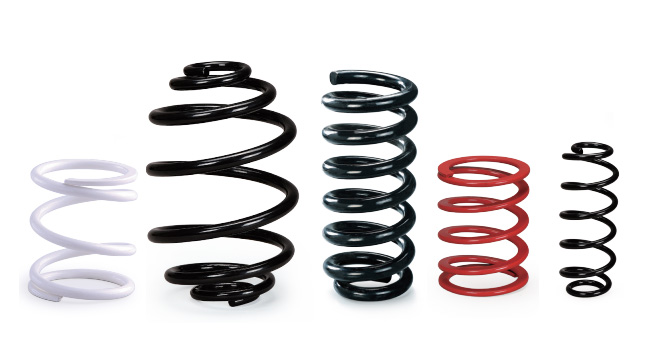 Modified Car Suspension Springs for Ride Height and LoadBrowse modified suspension springs for lifted, lowered, progressive, or heavy-load builds, where free length, rate, and installed height affect ride height.View Product →
When matching, ask for the spring's load at installed height, not just the rate. That single number tells you whether the spring will hold the car at the intended ride height with the actual corner weight.
Key Specifications to Confirm Before Ordering
The five specifications that prevent returns are wire diameter, outer diameter, free length, spring rate, and end type.
Buyers often compare only free length and end type. That is not enough. Wire diameter and coil count together set the rate. If a supplier changes wire diameter by 0.2 mm to hit a free length, the rate can shift by 5% to 8%. On a 3,000 lb car, that can mean 15 mm to 25 mm of ride height change at the corner.
| Specification | Typical tolerance | Why it matters |
|---|---|---|
| Wire diameter | ±0.05 mm to ±0.10 mm | Small changes shift spring rate and stress |
| Free length | ±2 mm for OE, ±5 mm for modified | Sets ride height and spring seating |
| Spring rate | ±3% to ±5% | Must match damper valving and load |
| Outer diameter | ±1 mm | Affects seat fit and clearance to tire or strut |
| End type | Tangential, pigtail, or ground | Wrong end type will not seat safely |
Material and Manufacturing: Where Fatigue Life Is Won or Lost
Fatigue life depends more on steel cleanliness, heat treatment, and shot peening than on a glossy coating.
A coil spring flexes millions of times. Inclusions in the steel can become crack starters. Proper heat treatment gives the spring its elastic range without making it brittle. Shot peening puts compressive stress on the surface and can add 20% to 40% to fatigue life. A coating that chips off early allows corrosion pitting, which also starts cracks.
A supplier that follows IATF/TS16949 and uses a full lab can show batch-level test data. Look for tensile testing, fatigue testing, and hardness reports. If a supplier cannot provide spring rate verification or a fatigue test report, the lowest price may become the highest cost after warranty claims.
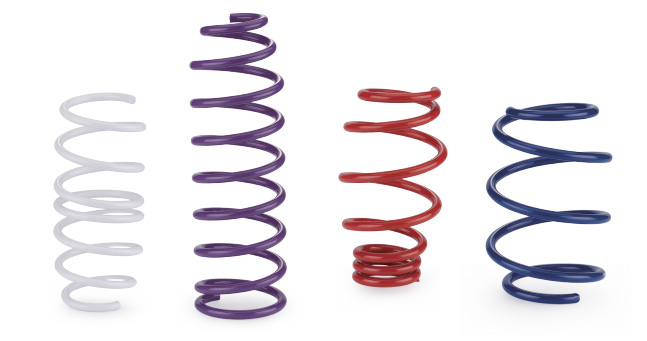 OE Replacement Automobile Suspension Springs for Factory Ride and LoadOE replacement coil springs restore factory ride height, load capacity, and handling; category details cover materials, testing, and fitment for cars, SUVs, trucks, and buses.View Product →
OE Replacement vs Modified Coil Springs: A Practical Comparison
OE replacement springs restore factory ride and load capacity; modified springs trade some comfort for stance and control.
Neither is universally better. The right choice depends on how you use the vehicle. A daily driver with a worn original spring usually benefits from an OE replacement that matches the original rate and free length. A car used for track days or show stance may need a modified spring with a higher rate and shorter free length, plus a matched shock.
| Goal | OE replacement | Modified spring |
|---|---|---|
| Ride quality | Factory-like comfort | Firmer, sometimes sharper |
| Load capacity | Restored to original | Can increase or decrease |
| Stance | Stock ride height | Lower or adjustable height |
| Damper matching | Works with stock or stock-replacement shocks | Requires revalved or adjustable shocks |
| Best for | Daily driving, repair, fleet | Performance, aesthetics, track use |
Linear vs Progressive Coil Springs for Shock Absorbers
Linear springs give predictable handling; progressive springs improve comfort under light load but complicate damper matching.
A linear spring has one rate. That makes it easier to predict how the car will respond and easier to match to a shock. A progressive spring has a softer initial rate and a stiffer final rate. It can smooth small bumps and still resist bottoming under load. However, the transition point may feel inconsistent if the shock is not tuned for it.
For most replacement coil springs for shocks, linear is the safer choice. Progressive springs are useful when the vehicle sees both light commuting and occasional heavy loads, but the buyer should confirm the installed height and the rate at the intended load. You can read more about linear and progressive coil springs before ordering.
Installation and Inspection: Avoiding the Most Common Mistakes
Most coil spring failures after replacement come from incorrect seating, reused worn mounts, or missing alignment.
Even a correctly rated spring can fail early if it is not installed properly. Use these checks:
- Confirm the spring end is seated in the pocket or on the seat. A spring that is rotated 180 degrees out of position can rub the strut or make noise.
- Replace upper and lower spring insulators if they are cracked, compressed, or oil-soaked. Old rubber can add 5 mm to 10 mm of ride height variation.
- Inspect the shock absorber. If it has oil leakage or more than 80,000 miles, replace it with the spring.
- Torque all suspension bolts at ride height, not at full droop, unless the service manual says otherwise.
- Check ride height at all four corners after 10 miles to 20 miles of driving. A difference of more than 10 mm side to side may indicate a seating problem.
FAQ
Here are answers to the questions buyers ask most often.
Can I use original shocks with new coil springs?
Yes, if the new springs match the original rate and free length. If you install stiffer or shorter springs, the original shocks may not control them. In that case, replace or revalve the shocks at the same time.
How do I know if my coil springs for shocks are worn?
Look for uneven ride height, a sagging corner, clunking over bumps, or visible rust and cracked coating. A spring can break at the bottom coil where water collects. If the car bottoms out on normal roads, the spring may have lost rate or the shock may have failed.
Do coil springs need to be replaced in pairs?
Yes, replace both sides on the same axle. A new spring on one side and a worn spring on the other can cause unequal roll stiffness and pulling. On four-corner vehicles, many shops recommend replacing all four if the others are original and high-mileage.
What is the difference between a coil spring and a shock absorber?
The coil spring supports the vehicle and absorbs the initial bump. The shock absorber controls the spring's bounce and keeps the tire on the road. They are different parts, but they must be matched to work well.
Are stiffer coil springs better for towing?
Only if the shock and load capacity support them. A stiffer spring reduces sag under tongue weight, but it can also make the empty truck ride harsh. Air bags or helper springs may be a better choice for occasional towing.
Choosing coil springs for shocks comes down to matching rate, free length, end type, and damper control—then verifying material and fatigue data. Get those details from the supplier in writing. A spring that fits the seat but not the load will cost more in labor and downtime than it saves at purchase. If you need help matching a spring to a specific vehicle or load, share the corner weight, intended ride height, and shock part number before ordering.