

 English
 中文简体
 Deutsch
 Español
Damping springs are the load-carrying half of a spring-and-damper pair: the spring absorbs the impact energy coming from the road, the payload, or a brake application, and the damper turns that energy into heat. Remove either half and the system fails. With only a spring, a body oscillates almost forever at roughly constant amplitude; with only a damper, there is no structure for the damper to act on. In a passenger car suspension, the tuning target is usually a damping ratio between about 0.2 and 0.4, so the body settles within a second or two of a bump instead of floating.
Content
- What People Actually Mean by Damping Springs
- Why a Spring Cannot Damp Itself
- The Three Damping Regimes and What They Feel Like
- Damping Spring Systems in Car Suspension
- Brake Springs: When Damping Behaviour Matters More Than Comfort
- Matching Damping Springs When You Modify a Suspension
- What to Check When Buying Damping Springs
- Frequently Asked Questions
What People Actually Mean by Damping Springs
Most people who say "damping springs" are describing a spring-damper system rather than a special type of spring, and that distinction is the single most useful thing to fix before any design or purchasing decision.
The phrase shows up in three different contexts, and mixing them up leads to real design errors:
- A spring-mass-damper model, the classic physics model used to predict how a body responds to road excitation.
- A spring with some internal damping, such as a coil spring wrapped around a damping sleeve, or a rubber and friction-based design.
- A spring-and-damper assembly, such as a shock absorber, a strut, or a brake return mechanism, where the two parts are engineered as one system.
This matters because springs and dampers follow opposite selection rules. Spring stiffness sets the frequency, which is how fast the body bounces. Damping sets how quickly that bounce stops. Changing stiffness without re-matching damping is a common root cause of a car that rides badly.
Why a Spring Cannot Damp Itself
A coil spring stores energy; it does not consume it, which is the key fact behind every practical damping discussion.
In an undamped spring-mass system, once it is excited it oscillates at the same amplitude indefinitely. Real springs lose a small amount of energy through internal material friction and end-coil contact, typically only 1 to 5 percent of the total system damping. For a suspension that is nowhere near enough, so the job of controlling vibration is handed to a separate damper. A shock absorber converts rod velocity into fluid forced through valves, producing a force that rises with speed when the body moves quickly and lets oil pass more easily during slow body motion.
This also explains why a stiff, short spring paired with a weak damper feels broken. The spring is not defective; there is simply nothing in the system responsible for stopping its motion.
The Three Damping Regimes and What They Feel Like
A well-tuned road-car suspension sits in the underdamped range, with just enough margin to handle the worst load case.
| Regime | Damping ratio | Real-world behaviour |
|---|---|---|
| Underdamped | Below 1, commonly 0.2 to 0.4 on cars | Body returns quickly after a bump with a slight overshoot; best balance of comfort and control |
| Critically damped | Equal to 1 | Fastest possible return to rest without overshoot; typically too harsh for a road car |
| Overdamped | Above 1 | Slow rebound, delayed settling, and a heavy, unresponsive feel |
Damping Spring Systems in Car Suspension
On a passenger car, the spring carries the static load and sets the body's natural frequency, while the damper sets how quickly body motion decays once that frequency is excited.
The division of labour looks like this:
- The spring carries part of the vehicle mass at each corner, for example around 400 kg at the front with a stiffness near 25 N/mm.
- Body natural frequency usually sits near 1.0 to 1.5 Hz at the front, with the rear slightly higher to stay above the pitch excitation frequency.
- Damper force rises with rod speed, so small slow body motions meet little resistance while fast wheel motions are strongly resisted.
That is also why a heavily loaded car or one fitted with stiffer springs can feel under-damped: the stiffer spring raises the frequency, but the dampers were still calibrated around the old stiffness. Raise spring rate by 20 percent against unchanged damping and the body rebound after a bump becomes louder and quicker than before.
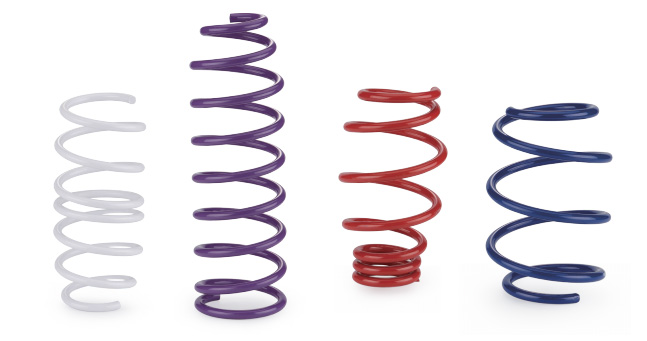 OE Replacement Automobile Suspension Springs and Coil Spring RangeCategory for OE replacement car suspension springs, covering coil types, spring rate, ride height, and dimensional specs for restoring handling and load capacity.View Product →
Brake Springs: When Damping Behaviour Matters More Than Comfort
In a braking system, the damping spring faces a different problem, and the deciding factor is elastic modulus stability across temperature rather than ride comfort.
A brake spring is heated by proximity to the engine and the brake disc, so the stiffness of a return spring changes between cold and hot conditions. If the elastic modulus drifts too far, pedal feel and brake release become inconsistent. Special heat treatment, quenching and tempering followed by stabilisation, is used to fix the microstructure so the modulus stays roughly linear from -40°C to 150°C.
Buyers of brake spring assemblies should verify four things:
- Load tolerance specified per application rather than taken from a generic catalogue value.
- Operating temperature and the relaxation limit at elevated temperature.
- Surface integrity, because a fatigue crack here is a safety event rather than a noise complaint.
- Batch-level traceability with load-deflection and hardness records attached.
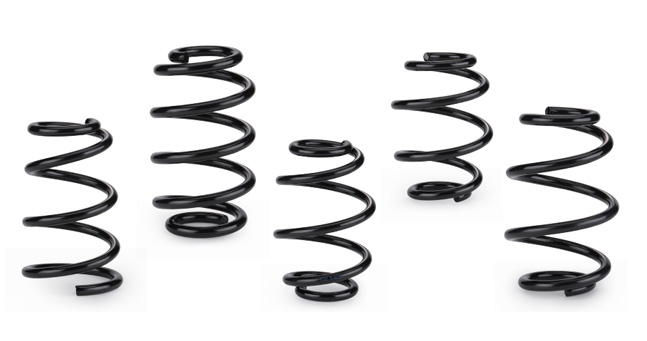 Brake Chamber Springs for Truck Air Brake SystemsCategory covering brake chamber power, return, and caging bolt springs, with material, load, fatigue, and chamber size guidance for commercial vehicle air brakes.View Product →
Matching Damping Springs When You Modify a Suspension
Lowering ride height or adding spring rate without re-valving the damping is one of the most common owner-level mistakes.
Dropping a car by 30 mm usually calls for 15 to 25 percent more spring rate to avoid compressing into the bump stops. The higher rate pushes body frequency up, and the original damper no longer has enough damping force at that frequency. The result is a car that floats over motorway crests and settles poorly on rebound.
Three practical rules help here:
- Progressive springs keep small compression comfortable and add support under hard cornering, which suits a daily-driven modified car.
- Linear springs make damper calibration more predictable and are more stable on track, but demand more careful damping matching.
- Fix the damping ratio target before the spring rate; stiffness sets the frequency, but the ratio sets the ride you actually feel.
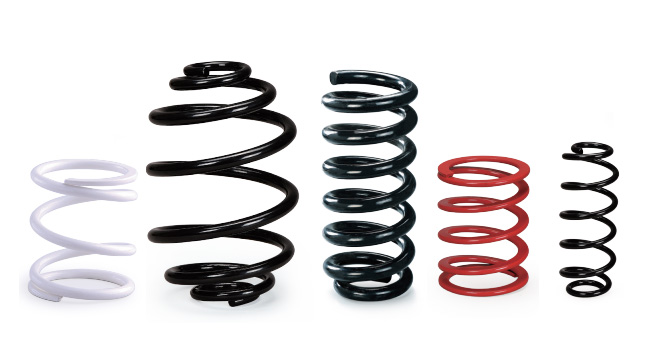 Modified Car Suspension Springs for Off-Road and Road UseCategory for modified suspension springs, covering lift kits, progressive and lowering springs, custom tuning, materials, and fatigue considerations for altered ride height.View Product →
What to Check When Buying Damping Springs
Purchasing risk in springs sits in fatigue life and batch consistency, not in unit price.
A cheaper spring that fatigues inside the warranty period costs far more than the price difference it saved.
| Check | What to confirm | Why it matters |
|---|---|---|
| Material and chemistry | Steel grade plus a spectrometer report | Carbon and alloy content drive fatigue limit and sag resistance |
| Load tolerance | Percentage tolerance at a stated height, for example plus or minus 5 percent | Loose tolerance produces side-to-side height mismatch and a crooked stance |
| Fatigue validation | Bench cycles to failure or a defined survival target | Determines whether the spring lasts past warranty or fails inside it |
| Shot peening and heat treatment | Process parameters and control records | Compressive residual stress at the surface is the main defence against fatigue cracking |
| Quality system | IATF/TS16949 certification, 6S discipline, batch traceability | OEM and tier-one customers treat this as a threshold requirement |
One useful habit: ask for the load-deflection curve before the production quotation, not after. The shape of that curve tells you whether consistency comes from process control or from sorting good parts out of a wide spread.
Frequently Asked Questions
Are damping springs the same thing as shock absorbers?
No. The spring stores energy and the damper dissipates it. On a car the two are packaged together, which is why the terms get mixed up in conversation, but they are selected on completely different criteria.
Can I change only the springs and keep the original dampers?
Yes, if the new spring rate is close to the original. Once the spring is significantly stiffer or shorter, the original damping no longer matches and the car will feel bouncy, floaty, or prone to bottoming out.
How long should a damping spring last?
Most passenger car springs are designed to outlast the vehicle, but sag, a broken coil, or corrosion pitting are reasons to replace them. Early signs of fatigue include a lower ride height, uneven side-to-side height, and a floaty feel; this overview of what car suspension springs do covers the diagnosis in more detail.
The term damping springs covers two components and more than one discipline. For a suspension engineer, the real question is never the spring on its own but the pairing of spring frequency with damping so the body settles predictably. For a buyer, the deciding evidence is fatigue validation, load tolerance, and process control rather than the number on a price list. Manufacturers such as Zhejiang Zongheng Spring Co., Ltd. build suspension and brake springs under IATF/TS16949 with fatigue and load verification on every batch, so if you need help translating a damping target into a spring specification, you can contact the team directly.