

 English
 中文简体
 Deutsch
 Español
A coil spring that has gone bad usually announces itself in five ways: one corner of the car sits lower than the rest, you hear a single clunk or a metallic "boing" over bumps and when turning the wheel at parking speed, the car bottoms out on dips it used to absorb, the steering feels vague or pulls to one side, and a visual check with the wheel removed shows a cracked, broken or heavily rusted coil. Two or more of those together point to the spring rather than the shock absorber. The noise-plus-visible-break combination is the one that means park the car, not "book it in next month".
Content
- What "Bad" Actually Means in a Coil Spring
- Seven Symptoms of a Bad Coil Spring, Ranked by Urgency
- Reading the Symptoms in More Detail
- Coil Spring or Worn Shock Absorber?
- What Makes Coil Springs Fail
- How a Workshop Confirms the Diagnosis
- Specifying Replacement Springs So the Failure Does Not Repeat
- What Happens If You Keep Driving on a Broken Spring
- Springs Beyond the Suspension
- Frequently Asked Questions
What "Bad" Actually Means in a Coil Spring
A bad coil spring is one that no longer carries its share of the vehicle's weight at the designed height and rate, or one that has a mechanical defect which will soon stop it doing so. Three failure modes cover almost every case you will meet in a workshop.
- Height loss (sag): the spring has lost free length through fatigue, so the corner sits low and the suspension spends its travel in the wrong place.
- Rate loss: the spring still holds the car up but has gone soft, so it bottoms out under load and lets the body roll further than it should.
- Mechanical damage: a crack, a broken end coil, or a corrosion pit deep enough to start one. This is the mode behind sudden noises and sudden failures.
Coil springs do not wear out smoothly like brake pads. They accumulate fatigue cycles, corrode where the coating has been chipped, and then fracture — most often at the top or bottom end coil, where the wire is formed into the seat and carries the highest local stress.
Seven Symptoms of a Bad Coil Spring, Ranked by Urgency
These are the symptoms that reliably show up before a spring breaks, ordered by how quickly someone should look at the car.
| Symptom | What you actually notice | Likely cause | Urgency |
|---|---|---|---|
| Uneven ride height | One corner sits 10–25 mm lower; the car leans on level ground | Fatigue sag or a broken end coil | Inspect within the week |
| Clunk or "boing" over bumps and when steering at parking speed | A single sharp metallic noise, usually worse on one side | Broken top coil shifting in its seat | Inspect immediately |
| Bottoming out on small dips | Harsh hits where the car used to glide; bump stops contacted often | Lost spring rate or reduced usable travel | Inspect within the week |
| Vague steering or a pull to one side | Car wanders and needs constant correction; pull that alignment cannot remove | Corner weight imbalance, changed camber | Inspect soon |
| Cupped or scalloped tire wear | Inner or outer shoulder wears in patches | Ride height change altering camber and toe | Inspect with alignment |
| Visible crack, rust blister or loose wire end | Brown staining under cracked paint; a short piece of wire rattling in the seat cup | Corrosion fatigue | Replace now |
| Sagging when loaded | Rear sits low with passengers or cargo; headlights point high | Spring under-rated for the load, or already sagged | Plan replacement |
Reading the Symptoms in More Detail
Sagging and uneven ride height
A car that leans by more than about 10 mm side to side, measured from wheel centre to arch on level ground at normal load, has a spring problem until proven otherwise. Check the easy things first — a tyre at the wrong pressure, a broken seat insulator, a bent lower arm — but on a car over 100,000 km, fatigue sag is the usual answer. A corner that has dropped 20 mm or more, or a spring that rattles when the suspension is hanging free, points to a broken end coil rather than simple sag.
Noise: the clunk and the "boing"
A single loud clunk or a ringing "boing" when you turn the wheel at low speed is the most specific symptom on the list. It happens because a fractured top coil has separated and is rotating or snapping back against its seat as the strut turns. A continuous rattle over rough ground is less specific — top mount bearings, anti-roll bar links and worn bushes imitate it closely. The test is simple: raise the car, let the suspension hang, and look at both end coils while an assistant turns the steering lock to lock.
Handling and tire wear changes
A bad spring changes the geometry before it changes the feel, so uneven tire wear can appear before the driver notices anything. When one corner sits low, static camber and toe shift with it, and the tyre on that corner scrubs in a scalloped pattern. If a fresh alignment cannot be brought back into specification, or the readings drift again within a few thousand kilometres, the spring is the reason, not the alignment rack.
Coil Spring or Worn Shock Absorber?
A bad spring changes where the car sits; a bad shock changes how it moves — that single distinction resolves most misdiagnoses, and shops regularly replace perfectly good struts while leaving a worn spring in place.
- Static vs dynamic: park on level ground and look at the stance. A low corner is a spring. A car that sits level but keeps bobbing after a dip is a damper.
- Fluid, not height: a leaking strut shows oil mist and road dirt stuck to the body. Springs do not leak; they rust.
- The bounce test: push a corner down and release. More than one rebound oscillation suggests the damper; a corner that starts low suggests the spring.
- Noise character: one sharp metallic crack at low speed is spring-related. A dull repetitive knock over rough ground is more often a mount or a bush.
What Makes Coil Springs Fail
Fatigue and corrosion working together cause the overwhelming majority of coil spring failures; impact damage is usually only the trigger that opens a crack which a corrosion pit had already started.
- High-cycle fatigue: a suspension spring sees hundreds of thousands of load cycles in normal use, and it is designed against a fatigue life rather than infinite life. Past that life, cracks initiate in the highest-stress region of the end coil.
- Coating damage: a stone chip breaks the powder coat, moisture gets in, and the resulting pit acts as a stress raiser. Most broken springs show a rust stain right at the fracture origin.
- Chronic overloading: vans, tow vehicles and cars that habitually run near maximum load use up their fatigue life faster.
- Single overload events: potholes and kerb strikes can exceed design stress once, which is enough on an already-corroded wire.
- Wrong or mismatched fitment: a spring that does not match the seat insulator, or a pair with different part numbers, produces the same symptoms from day one.
The progression is well documented — the early warning signs of suspension spring fatigue tend to appear long before the wire finally separates.
How a Workshop Confirms the Diagnosis
Measure before replacing anything: four ride-height readings and three wire-diameter readings will confirm or rule out a bad spring in about fifteen minutes, without dismantling the strut.
- Measure wheel-centre-to-arch height at all four corners on level ground at normal load. More than roughly 10 mm difference across an axle is a flag.
- Raise the car and let the suspension hang, then inspect both end coils sitting in their seats for a gap, a fresh fracture face or a loose piece.
- Look at the coating on the lower coils — brown staining under cracked paint means a corrosion pit is already forming.
- Measure wire diameter with a caliper at three points and compare with the OE specification; a spring that measures undersize has lost material to corrosion.
- Check the seat insulators, top mount bearing and bump stop. A collapsed insulator imitates a broken spring's noise almost exactly.
- If the part is off the car and still in doubt, bench-test it: free length, load at design height and rate. A spring that is within tolerance on length but low on load has lost rate, not height.
That bench data is what separates a diagnosis from a guess. Our own production batches go through a full laboratory sequence — spectrometer checks on incoming wire, load and rate testing, fatigue cycling, side-load measurement, and gravel-impact testing of the coating — so each batch has documented characteristics rather than a nominal catalogue figure.
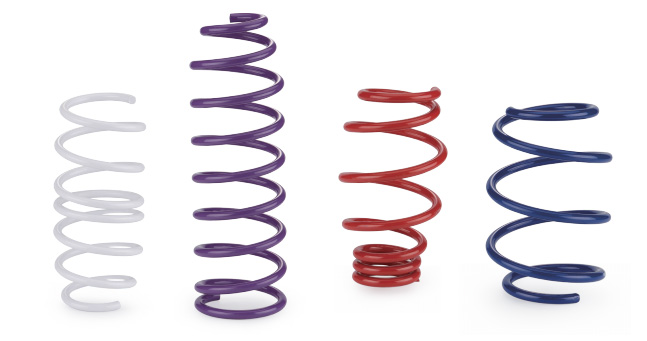 OE Replacement Automobile Suspension SpringsBrowse OE replacement coil springs matched by free length, rate and coating, with documented batch testing to support axle-pair replacement.View Product →
Specifying Replacement Springs So the Failure Does Not Repeat
Replace springs in axle pairs and match the original free length, rate and coating — one new spring on a single corner will make the car sit and handle worse than the worn pair did.
- Pair replacement: both sides of an axle, every time. A new spring against a 120,000 km spring loads the two corners unequally and upsets brake balance under heavy braking.
- Match the code, not just the model: engine weight, options and market variants change the spring specified for the same body shell. Use the spring code or colour marking on the original wire.
- Write the specification down: wire diameter with tolerance, free length, load at design height and rate. Those four numbers are what a supplier should be able to certify.
- Ask about protection: coating type, coating thickness and salt-spray hours. Corrosion is the failure initiator, so the finish is a functional requirement, not cosmetics.
- Renew the consumables: insulators, seats and bump stops are cheap next to a second strip-down. Reuse a collapsed insulator and the new spring will clunk within a month.
- Align afterwards: ride height changes camber and toe, so a four-wheel alignment belongs in the same visit.
Where the owner wants a lower stance or more control under load, a progressive or uprated spring is the sensible route rather than cutting or heating the original — the full coil spring product range covers both original-equivalent replacement and uprated fitments, with rate and length specified per application.
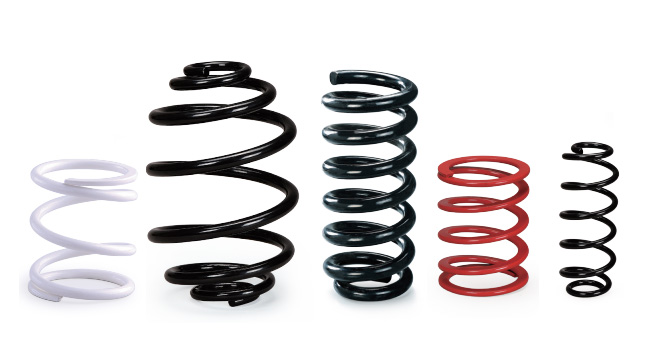 Modified Car and Off-Road Suspension SpringsView modified and off-road coil springs for lift, progressive rate, heavy-load assist or lowering, with application-specific rate and length options.View Product →
What Happens If You Keep Driving on a Broken Spring
A broken coil spring can leave the vehicle: the fractured end coil may rotate out of its seat, rub through a tyre sidewall, or jam against the lower control arm or the inner wing.
Even before that, the car is running with one corner lower and softer than designed. Braking stability degrades because the loaded corner carries a different share of the weight transfer, and the spring that has already cracked has very little margin left — the crack normally takes thousands of kilometres to grow from a pit to a break, but once the wire is separated, the remaining pieces move freely. A low-speed drive to a nearby workshop is reasonable if the broken end is still fully seated and clear of the tyre. Anything else, including metal-on-metal noise or a spring touching the tyre, means recovery rather than driving.
Springs Beyond the Suspension
The same fatigue logic applies elsewhere on the vehicle, and it is worth extending an inspection beyond the four corners. Brake system springs work in a harsher environment — heat cycling, moisture and road salt — and a return or tension spring that has lost preload changes how a brake component releases or retracts. Because that behaviour is safety-related rather than comfort-related, brake springs are specified for their operating temperature range, with heat treatment and shot peening chosen to hold load at both extremes rather than only at room temperature.
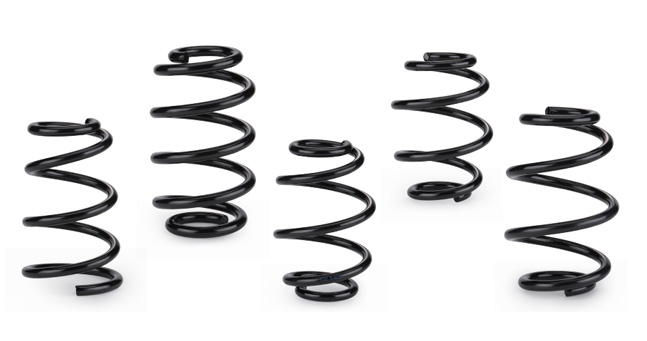 Brake Chamber Springs for Commercial VehiclesCompare brake chamber compression springs for trucks, buses and trailers, specified for heat, load and fatigue demands in parking and service brakes.View Product →
Frequently Asked Questions
Can I drive with a broken coil spring?
Only a short, low-speed trip to a workshop — and only if the broken end is seated and clear of the tyre. If the spring is touching the tyre, making metal-on-metal contact or the ride height has dropped sharply, have the car recovered rather than driven.
Do coil springs sag with age?
Yes, a small amount of settling over 100,000 km is normal, but more than about 10 mm side to side is not. Noticeable sag is a fatigue symptom of the spring itself; new shock absorbers will not correct it, which is why replacing struts alone often leaves the car sitting exactly as low as before.
Will a bad coil spring cause uneven tire wear?
Yes, indirectly. A change in ride height alters static camber and toe on that corner, so the tyre scrubs in a scalloped or cupped pattern. Uneven wear that returns after a correct alignment usually traces back to a spring.
How long do coil springs normally last?
Typically 100,000 to 150,000 km, and less on poor road surfaces, in heavy-load service or in salt-treated regions. Corrosion history shortens service life more than mileage does, so a low-mileage car used through winters can need springs before a high-mileage one.
Which side usually fails first?
There is no fixed rule, but the side that takes more kerb strikes, potholes and standing water tends to go first — in right-hand traffic markets that is often the nearside front. Replace both sides regardless.
Bad coil spring symptoms are cumulative rather than dramatic: a lean you stop noticing, a clunk you turn the radio up for, a tyre that wears oddly for no obvious reason. The useful habit is to measure rather than listen — four ride-height readings and one look at the end coils with the wheel off will tell you more than a road test. And if a spring has broken, treat the matching spring on the other side of that axle as due for replacement, because it has lived exactly the same life.