



 English
 中文简体
中文简体 Deutsch
 Español
Understanding the Foundation: What are Two Basic Types of Automobile Suspension Springs?
Apr 16, 2026
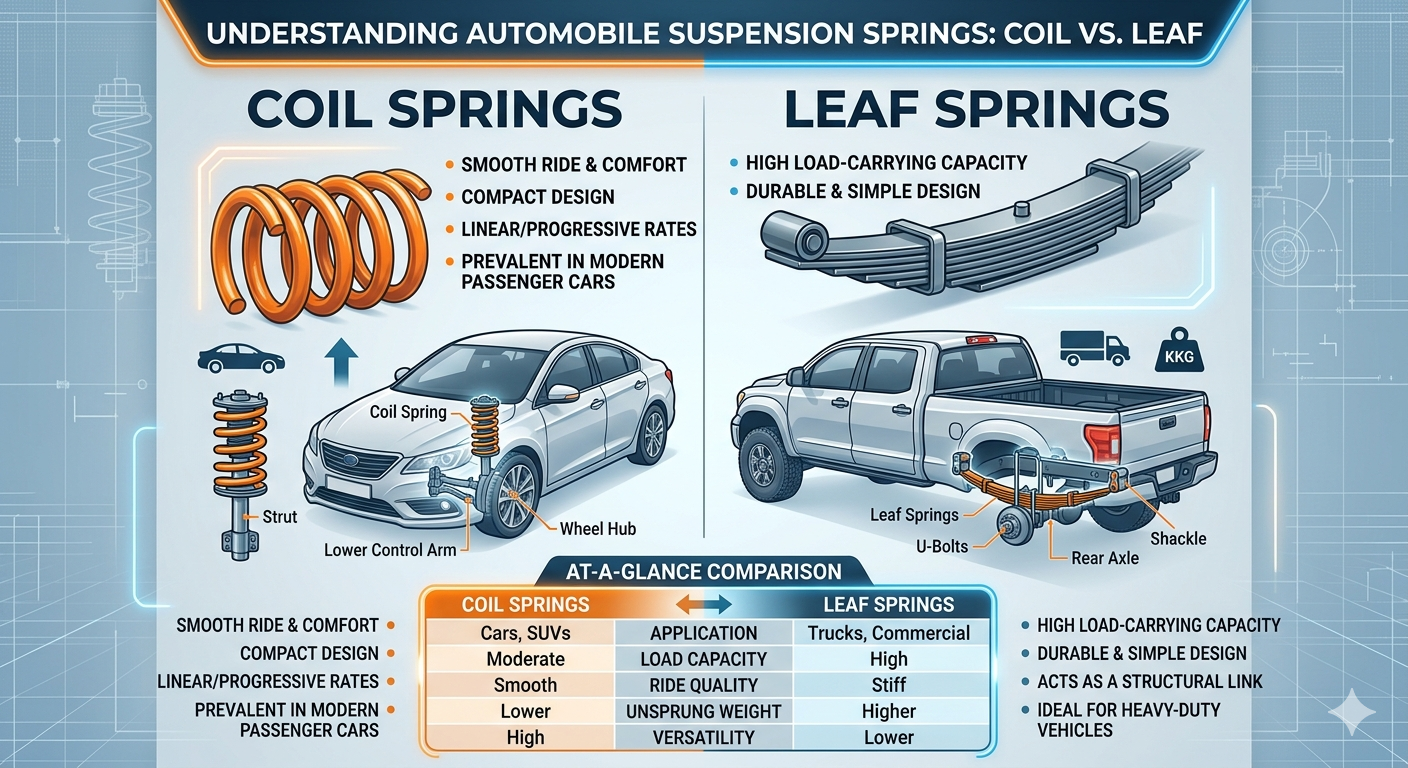
The two basic types of automobile suspension springs are coil springs and leaf springs. These two components represent the fundamental technology used to support vehicle weight and absorb road shocks across the vast majority of modern and classic automotive designs. While other systems like air springs or torsion bars exist, the coil and leaf variations remain the industry standards due to their reliability, cost-effectiveness, and proven performance over decades of engineering evolution.
Content
- The Role of Coil Springs in Modern Automotive Engineering
- The Enduring Utility of Leaf Springs in Heavy-Duty Vehicles
- Comparative Analysis: Coil Springs vs. Leaf Springs
- Technical Performance Factors and Material Science
- Maintenance and Signs of Failure for Suspension Springs
- Evolution and Future Trends in Spring Technology
- Frequently Asked Questions (FAQ)
- Final Thoughts on Suspension Choices
The Role of Coil Springs in Modern Automotive Engineering
Coil springs are the most prevalent type of suspension spring found in modern passenger cars, providing a balance of compact design and excellent ride comfort. By utilizing a heavy-duty steel wire wound into a helical shape, these springs compress and expand to manage the vertical movement of the wheels.
The mechanical principle behind a coil spring is based on torsion. As the spring compresses, the wire itself actually twists, storing energy that is then released to push the wheel back toward the ground. This design allows for a significant amount of travel within a relatively small vertical space, making it ideal for independent suspension systems.
Advantages of Coil Spring Systems
The primary advantage of coil springs is their ability to offer a highly tunable spring rate, which directly influences the vehicle's handling characteristics. Engineers can vary the thickness of the wire, the diameter of the coil, and the number of turns to create either a soft, comfortable ride or a stiff, sporty performance feel.
- High degree of flexibility in suspension geometry design.
- Reduced weight compared to traditional heavy-duty alternatives.
- Compatibility with MacPherson strut and multi-link suspension setups.
- Linear or progressive compression rates depending on the coil spacing.
The Enduring Utility of Leaf Springs in Heavy-Duty Vehicles
Leaf springs are one of the oldest forms of vehicle suspension, consisting of several layers of flexible steel strips (leaves) stacked together to act as a single unit. This type of spring is primarily utilized in rear suspensions for pickup trucks, vans, and heavy-duty commercial vehicles because of its exceptional load-carrying capacity.
Unlike coil springs, leaf springs serve a dual purpose: they act as a damping member and a structural link. Because they are bolted directly to the vehicle's chassis and the axle, they help locate the axle without the need for additional control arms, simplifying the overall suspension architecture for rugged applications.
Characteristics of Leaf Spring Design
Modern leaf springs generally come in two variations: multi-leaf and mono-leaf. Multi-leaf systems use several layers of varying lengths to provide a progressive resistance—as more weight is added, more leaves engage to support the load.
- Superior distribution of chassis stress across a wider area of the frame.
- Simplified design that reduces the number of moving parts in the rear axle assembly.
- High durability under extreme weight conditions and off-road environments.
- Ease of repair and replacement in commercial fleet settings.
Comparative Analysis: Coil Springs vs. Leaf Springs
Choosing between coil springs and leaf springs depends entirely on the intended use of the vehicle and the desired balance between comfort and utility. While coil springs dominate the consumer car market for their smooth ride, leaf springs remain the king of the industrial and hauling sectors.
| Feature | Coil Springs | Leaf Springs |
| Primary Application | Sedans, SUVs, Performance Cars | Trucks, Vans, Commercial Trailers |
| Load Capacity | Moderate | High to Very High |
| Ride Quality | Smooth and Compliant | Stiff (especially when empty) |
| Space Requirement | Compact / Vertical | Large / Horizontal |
| Manufacturing Cost | Lower per unit | Higher (material intensive) |
Table 1: Technical comparison between the two basic types of automobile suspension springs.
Technical Performance Factors and Material Science
The effectiveness of automobile suspension springs is rooted in material science, specifically the use of high-tensile chrome silicon or chrome vanadium steel. These alloys are chosen for their high elastic limit, ensuring that the spring returns to its original shape even after millions of cycles of compression.
For instance, in a standard passenger vehicle, a coil spring might have a spring rate of 300 lbs/inch. This means for every 300 pounds of force applied, the spring compresses exactly one inch. In contrast, a heavy-duty leaf spring pack on a commercial vehicle might have a progressive rate that starts at 500 lbs/inch and increases to 1,200 lbs/inch as the vehicle reaches its maximum payload. This prevents the suspension from "bottoming out" under heavy stress.
Impact on Unsprung Weight
One critical technical metric in suspension design is unsprung weight—the mass of the suspension, wheels, and other components directly connected to them, rather than supported by the springs. Coil springs contribute significantly less to unsprung weight than leaf springs. Lower unsprung weight allows the tires to track road imperfections more accurately, which is why almost all high-performance racing vehicles utilize sophisticated coil-over-shock configurations.
Maintenance and Signs of Failure for Suspension Springs
Maintaining the two basic types of automobile suspension springs is vital for vehicle safety, as a broken spring can lead to loss of control or tire damage. While springs are designed to last the lifetime of the vehicle, environmental factors like road salt and extreme hauling can cause premature failure.
For coil springs, the most common failure mode is corrosion leading to a stress fracture. A snapped coil can cause the vehicle to sit unevenly or create a loud "clunking" noise when driving over bumps. For leaf springs, the most common issues are "sagging" (loss of arch) or the snapping of individual leaves within the pack.
- Visual Inspection: Look for cracks, heavy rust, or leaning to one side.
- The Bounce Test: Push down on a corner of the vehicle; if it bounces more than twice, the dampers or springs may be worn.
- Tire Wear: Uneven tire wear patterns often point to a sagging spring that has altered the wheel alignment.
Evolution and Future Trends in Spring Technology
While coil springs and leaf springs remain the standards, the automotive industry is seeing a shift toward composite materials. Some modern vehicles have replaced traditional steel leaf springs with fiber-reinforced plastic (FRP) mono-leaf designs. These offer the same strength with a 70% reduction in weight, significantly improving fuel efficiency and ride quality.
Furthermore, the rise of electric vehicles (EVs) is placing new demands on suspension systems. Because EVs carry heavy battery packs, their springs must handle higher constant loads while maintaining a quiet, vibration-free cabin. This has led to the development of sophisticated "variable pitch" coil springs that can remain soft over small ripples but stiffen instantly during cornering or braking.
Frequently Asked Questions (FAQ)
1. Which type of spring is better for off-roading?
It depends on the goal. Coil springs generally offer better "articulation" (the ability of wheels to move independently over large obstacles), while leaf springs are preferred for heavy-duty overlanding where carrying gear and fuel is the priority.
2. Can I replace leaf springs with coil springs?
Yes, but it requires a complete suspension conversion kit. Since leaf springs also locate the axle, a conversion to coils requires adding control arms and a track bar to hold the axle in place, which is a major engineering undertaking.
3. Why do some vehicles use both?
Many pickup trucks use coil springs in the front for precise steering and comfort, while using leaf springs in the rear to handle the payload in the truck bed. This hybrid approach utilizes the strengths of both basic types.
4. How long do automobile suspension springs typically last?
In ideal conditions, suspension springs can last over 150,000 miles. However, in regions with heavy snow and road salt, they may require replacement much sooner due to corrosion-induced fatigue.
Final Thoughts on Suspension Choices
Understanding what are two basic types of automobile suspension springs is the first step in appreciating the complex engineering that keeps our vehicles stable and safe. Whether it is the versatile and comfortable coil spring or the rugged and reliable leaf spring, both technologies continue to play a critical role in the global transport infrastructure. As materials and vehicle weights evolve, these two basic types will likely remain the foundation of automotive suspension for many years to come.

- ADD: No. 75 Xingye Road, Fengqiao Town, Zhuji City, Zhejiang Province, China
- Tel: +86-575-87599266
- Mob: +86-13675761610
- Email: [email protected]
Copyright © Zhejiang Zongheng Spring Co., Ltd. Rights Reserved. China automotive coil springs manufacturers Wholesale suspension springs factory
