

 English
 中文简体
 Deutsch
 Español
Coil springs come in three functional families: compression, extension and torsion. Every other name you will meet in a catalogue — linear, progressive, conical, barrel, hot-wound, chrome-silicon, crossover hook — is a modifier describing rate behaviour, geometry, material or end detail inside one of those three families. Get the family right and you have fixed the load direction; get the modifier right and you have fixed the fatigue life.
A coil spring is a helical elastic element that stores energy by deflecting along its axis (compression, extension) or about its axis (torsion). Stiffness is governed by wire diameter, mean coil diameter and active coil count, which is why two springs with identical outer dimensions but different rate profiles can behave completely differently on the same test rig. That is the practical reason "types of coil spring" is a question about behaviour, not just about shape.
Content
- The Three Core Types of Coil Spring
- Compression Spring Sub-Types and Rate Profiles
- Extension Spring Types and Hook Styles
- Torsion Spring Types and Leg Configurations
- Types of Coil Spring by Material and Winding Process
- Types of Coil Spring by Application
- How to Match a Coil Spring Type to Your Application
- Frequently Asked Questions
Compression
Pushes back against a compressive load. The workhorse type for suspension, valves, clutches and presses.
Extension
Pulls back against a tensile load. Defined by wound-in initial tension and by hook geometry.
Torsion
Twists back against rotation. Defined by leg angle, winding direction and coil body count.
The Three Core Types of Coil Spring
Compression springs resist a pushing load, extension springs resist a pulling load and torsion springs resist rotation — those three load directions define the category before wire size, material or finish is even discussed.
In practice the family decides the failure mode. Compression springs suffer buckling, coil clash and load loss from sustained compression; extension springs usually break at the hook; torsion springs break at the leg or bind when the inner diameter closes onto the shaft. Knowing that in advance tells you which drawing dimensions deserve the tightest tolerance.
| Family | Load direction | Typical end detail | Common applications | Watch out for |
|---|---|---|---|---|
| Compression | Axial push | Closed, closed and ground, open, open ground | Vehicle suspension, valves, clutches, industrial presses | Buckling, coil clash, sag under static load |
| Extension | Axial pull | Machine hook, crossover hook, side hook, full loop | Return mechanisms, brake shoe retraction, counterbalances | Hook fracture, over-stress at the first and last coil |
| Torsion | Rotation about the axis | Straight, angled or hooked legs | Hinges, clamps, brake adjusters, closures | Leg breakage, diameter shrink, wrong winding direction |
Compression Spring Sub-Types and Rate Profiles
Within compression springs the most consequential choice is the rate profile — linear, progressive or variable pitch — because that governs how the spring behaves under load, not merely how it fits in the seat.
A linear spring adds the same force for every millimetre of travel. A progressive spring closes some coils early in the stroke, so the rate climbs as the load climbs: softer over small bumps, firmer when the vehicle is loaded or the suspension is deep into its travel. For a replacement spring on a road car, that difference is often the whole reason one part feels correct and another feels harsh.
| Profile | Behaviour through travel | Practical benefit | Typical use |
|---|---|---|---|
| Linear (constant rate) | Even rate from free length to solid height | Predictable, simple to validate on a load tester | Fixed-load machinery, motorsport setups with known corner weights |
| Progressive / variable pitch | Rate rises as coils progressively close | Comfort when lightly loaded, capacity when heavily loaded | OE replacement suspension, estate and light commercial vehicles |
| Conical / tapered | Rate rises sharply; coils nest instead of clash | Compact solid height, good buckling resistance | Clutches, battery contacts, seating mechanisms |
| Barrel / hourglass | Rising rate with a wider central coil | Better lateral stability, less rubbing against the seat | Thick-wire suspension springs, vibration isolators |
End configurations change the type too
End style is not cosmetic: a ground end transfers load across a full 360 degrees of wire, an unground end transfers it across roughly 270 degrees, and that difference shows up as off-axis loading and premature seat wear.
- Closed plain — coils touch at both ends, cheapest, acceptable for light duty.
- Closed and ground — ends squared and ground flat, the default for suspension and any application with a flat seat.
- Open — pitch continues to the end, used where the spring sits in a cup or on a rod.
- Open and ground — open pitch with a ground bearing surface, used when a defined installed height matters.
If you are still deciding between a constant-rate and a rising-rate design for a road vehicle, this comparison of linear and progressive OE replacement suspension springs walks through the load cases that usually settle the argument.
For automotive work, the compression family narrows fast: the geometry constraints of the strut seat, the wire diameter needed for the corner weight and the coating needed for the environment leave very few viable variants.
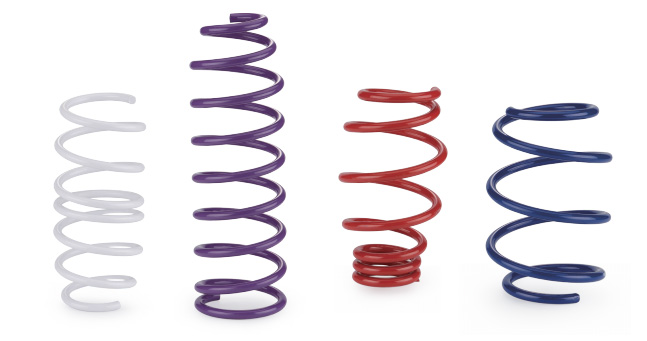 Automobile Suspension Springs for OE ReplacementReview OE replacement suspension springs specified by free length, spring rate, and end configuration to restore ride height and load capacity.View Product →
Extension Spring Types and Hook Styles
Extension springs are typed by two features — initial tension and hook style — and in service it is almost always the hook that fails first.
Initial tension is the force wound into the coils that must be overcome before the spring starts to deflect. It is set during coiling and is difficult to adjust afterwards, so it belongs on the drawing as a measured value rather than a wish. Too little and the mechanism rattles; too much and the end coils are pre-stressed before the spring has done any work.
- Machine hook — a full bend formed from the last coil, strongest general-purpose option.
- Crossover hook — the wire crosses the body centreline, used where the hook must sit on a pin.
- Side hook — hook offset to one side, useful in tight housings.
- Extended hook — a long straight leg before the bend, for reach rather than strength.
- Full loop or half loop — distributes load over a wider contact area and reduces hook stress.
Torsion Spring Types and Leg Configurations
Torsion springs are typed by leg configuration, winding direction and number of bodies, because those three choices decide whether torque arrives in the direction the mechanism needs.
A torsion spring stores energy by winding tighter. Specify the hand correctly: a spring wound the wrong way does not simply work less well, it unwinds under load. Working deflection is normally capped well below the point where the inner diameter closes onto the shaft, since that contact changes both the rate and the friction of the assembly.
- Single body with straight legs — the standard hinge and clamp spring.
- Single body with angled legs (90, 135 or 180 degrees) — positions the leg against a specific abutment.
- Double torsion — two bodies joined by a central bridge, doubling torque in the same envelope and balancing side loads.
- Opposed or mirrored pairs — used where torque must be applied symmetrically, as in some latch and brake adjuster designs.
Types of Coil Spring by Material and Winding Process
Material and winding route are type decisions rather than afterthoughts, because together they set the stress the spring can carry and the fatigue life it can realistically reach.
| Material | Typical wire range | Strength and temperature | Usual application |
|---|---|---|---|
| Music wire (ASTM A228) | Small diameters | High tensile, moderate temperature ceiling | Small mechanisms, return springs, general purpose |
| Oil-tempered (ASTM A229) | Small to medium | Good toughness, economical | Shock-loaded components, industrial assemblies |
| Chrome-vanadium (ASTM A231) | Medium | Good fatigue resistance, needs a protective coating | Suspension and valve springs |
| Chrome-silicon (ASTM A401) | Medium to heavy | High stress capability, better heat resistance | Automotive suspension, high-cycle springs |
| Stainless 302 / 304 | Small to medium | Corrosion resistance, lower allowable stress | Marine, food equipment, wet environments |
Winding route follows size and stress. Cold coiling suits smaller wire and gives tighter dimensional control; hot coiling is used for heavy wire where the material must be formed above its recrystallisation point. Either way, the type is only finished after stress relieving, shot peening to raise fatigue strength, presetting (scragging) to stabilise free length, and a coating chosen for the environment — powder coat, e-coat, zinc phosphate or plating.
Types of Coil Spring by Application
The same three families reappear across industries, but each application pushes a different requirement to the top of the specification.
Automotive suspension coil springs
Suspension springs are compression springs with the tightest combination of requirements: high stress, long fatigue life, stable free length and corrosion protection measured in hundreds of hours of salt spray. OE replacement parts must restore factory ride height and load capacity; performance parts deliberately change rate and ride height. Both are the same family, separated entirely by the rate profile and free length on the drawing.
Brake system springs
Brake springs are compression or extension springs working in a harsh thermal cycle, where elastic modulus shifts with temperature and the wire must hold its properties from deep cold to brake-fade heat. Return springs in drum brakes, adjuster springs and springs inside caliper and booster assemblies all sit in this group, and heat treatment is what keeps their microstructure stable.
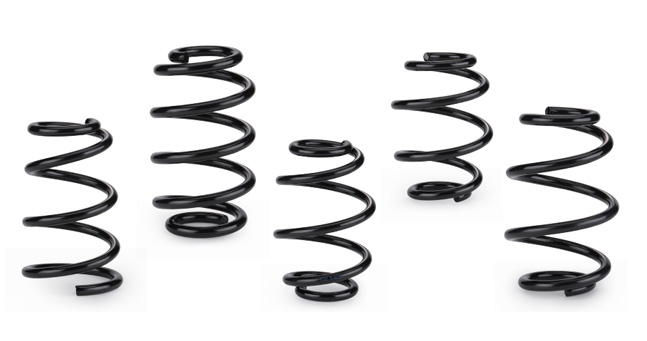 Brake Chamber Springs for Trucks and Heavy VehiclesReview brake chamber compression springs for air brake systems, including power, diaphragm return, and caging bolt springs matched to chamber size.View Product →
General-purpose industrial coil springs
Industrial coil springs cover everything from conveyor tensioning to pump seals and packaging machinery. Here the priorities shift towards repeatability, cost per piece and availability in volume, which usually means linear rate, oil-tempered wire and a simple protective finish.
How to Match a Coil Spring Type to Your Application
Match the type to the load path first, then to the space envelope, and only then to the material — reversing that order is the most common reason a spring has to be redesigned after tooling.
- Confirm load direction and magnitude, including any preload or initial tension.
- Define travel and required rate, then choose linear, progressive or variable pitch.
- Fix the envelope: outer diameter, inner diameter, free length and solid height.
- State the environment: operating temperature range, humidity, salt spray hours, expected cycle count.
- Specify the interface: end type, hook style, leg angle, winding direction.
- Agree the inspection data: rate tolerance, free length tolerance, load at installed height, and the test method for each.
As a working baseline for automotive work, rate is usually held to around plus or minus 5 percent, free length to within about 1 to 2 percent, and load at installed height to roughly plus or minus 5 to 8 percent. Anything tighter than that needs to be justified by the mechanism, because it raises scrap rate and unit price. Fatigue targets are set separately and should be quoted as cycles at a stated stress range, not as a vague "long life".
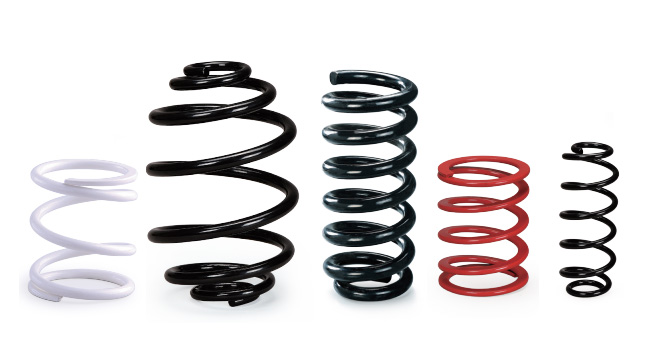 Modified Car and Off-Road Suspension SpringsCompare lift, progressive, heavy-load assist, and lowering springs with re-specified rate, free length, wire diameter, and coating for modified vehicles.View Product →
For vehicles that are lowered, loaded or driven hard, a modified spring is not simply a shorter version of the original: rate, wire diameter, coating and free length are re-specified as a set, and mixing a modified spring with standard dampers is a frequent source of poor body control. Buyers who need several families from one supplier can review the full coil spring range and request rate and load data per batch.
Explore our full coil spring product range to compare suspension, brake and general-purpose types on the same specification basis.
Frequently Asked Questions
What are the main types of coil spring?
Three: compression, extension and torsion. Compression springs resist pushing, extension springs resist pulling and torsion springs resist rotation. Sub-types such as linear, progressive, conical, barrel or hourglass describe how the rate behaves within the compression family, not a separate category.
How do I know which type my vehicle needs?
Start from the original part: the mounting style tells you the family, and the free length, wire diameter and coil count indicate the rate. If the car is standard height and load-carrying, a progressive replacement is usually the safer choice; if the suspension has been deliberately modified, the rate and length must be matched to the new corner weight and damper.
Is a hot-wound spring stronger than a cold-wound spring?
Not inherently. Hot winding is a processing necessity for heavy wire, while cold winding suits smaller wire and gives better dimensional consistency. Strength comes from material grade, wire diameter, stress level and the post-forming operations such as stress relieving, shot peening and presetting.
How long should a coil spring last?
It depends on stress range rather than time. A lightly stressed industrial spring may exceed a million cycles; a suspension spring on a loaded vehicle works in a much higher stress band and is normally validated to a defined cycle count at a stated load. Ask for that number on the drawing and test it, rather than relying on a general lifespan claim.